You'll feel stronger in 2 weeks. You'll see mirror changes at 6-8 weeks. Friends and family will notice at 10-12 weeks. Substantial body recomposition takes 6 months of consistent training. Those are the real timelines — not the "30-day transformation" marketing on Instagram. These figures assume you train 3-5 days per week with progressive overload, eat 1.6-2.2 g/kg of protein, and sleep enough to recover. Below each number is research — every claim in this article is backed by published sports-science literature, not gym-bro folklore.
The hardest weeks are the first 4. You're putting in the work, your strength is climbing, but your body looks the same in the mirror. This is where most people quit. If you understand the timeline and what's actually happening internally — your nervous system is rewiring before your muscles grow — you'll push through the invisible phase and reach the visible one.
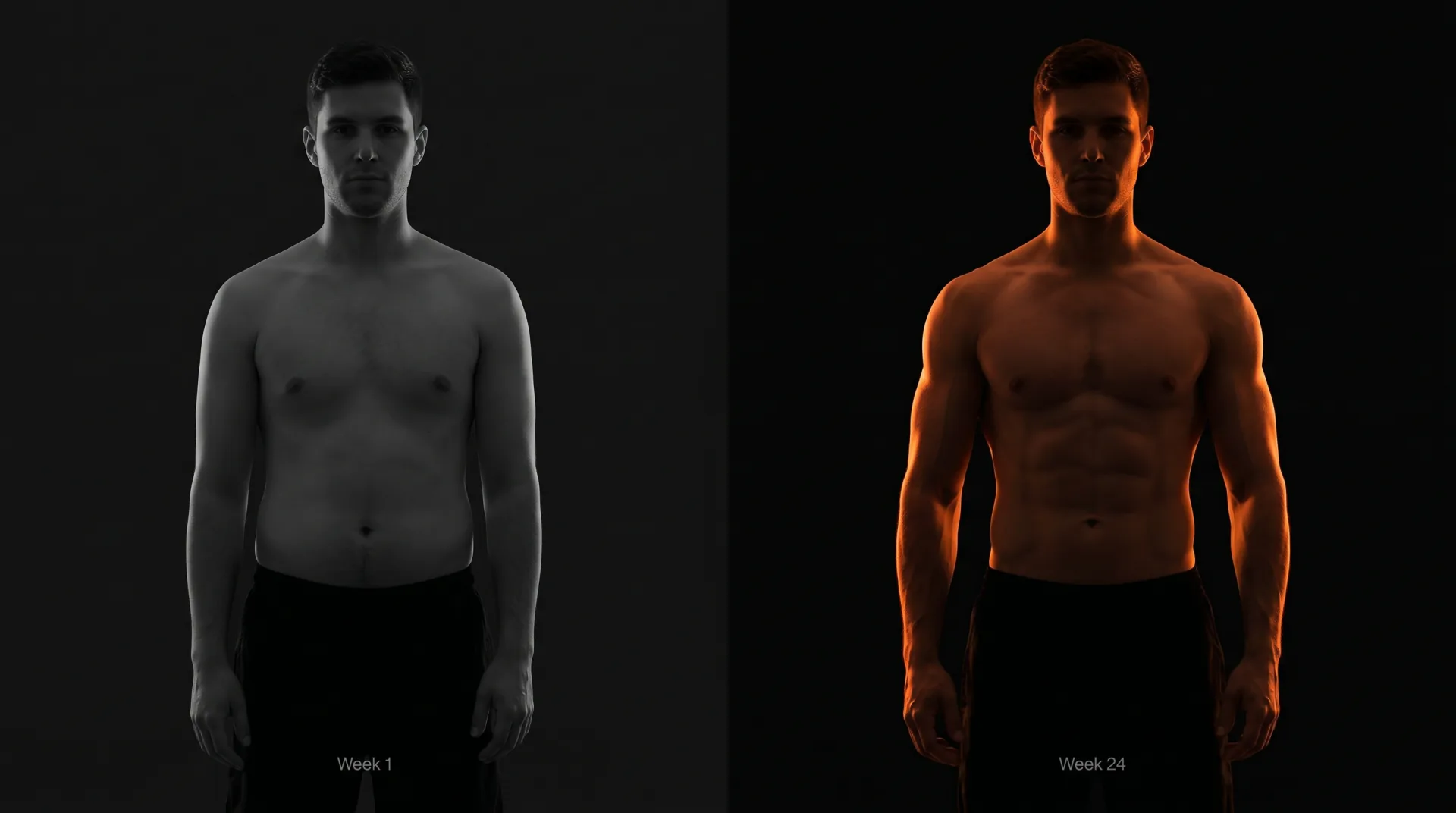
The Week-by-Week Timeline
Weeks 1-2: Neural Adaptation (nothing visible)
What's happening: Your central nervous system is learning the lift patterns. Motor-unit recruitment improves, antagonist muscle interference decreases, movement efficiency goes up. Your muscles haven't grown yet.
What you'll notice: Weights feel lighter. You add reps or small weight jumps every session. Soreness (DOMS) is intense the first week, decreases by week 2.
Research: A 2016 study in Frontiers in Physiology by Schoenfeld et al. documented significant strength gains in 2-3 weeks with minimal change in muscle cross-sectional area — confirming the early strength-precedes-size pattern.
Weeks 3-4: First Tangible Gains
What's happening: Continued neural gains + early muscle protein synthesis ramp-up. Mitochondrial density increases. Capillary networks start adapting. Work capacity goes up measurably.
What you'll notice: Compound lifts add weight consistently. Recovery between sets improves. You can carry groceries or climb stairs without noticing. Pump feels bigger after sessions (but deflates by morning).
Weeks 6-8: First Visible Changes
What's happening: Measurable muscle hypertrophy. Glycogen stores in muscles increase. Body composition begins to shift if nutrition is on target.
What you'll notice: Arms look slightly fuller when flexed. Shoulders show more definition in a T-shirt. Pants may fit looser in the waist if you're in a deficit. You can see veins in the forearms where you couldn't before.
Research: A 2019 study in Medicine & Science in Sports & Exercise by Damas et al. measured a 7-10% increase in vastus lateralis cross-sectional area after 8 weeks of resistance training in previously untrained men — the first statistically significant muscle growth most studies detect.
Weeks 10-12: Friends and Family Notice
What's happening: Cumulative hypertrophy + fat-loss/recomp produce externally visible change. Posture improves (stronger back + core = standing taller). Confidence in clothes increases.
What you'll notice: Someone you haven't seen in a few weeks comments ("have you been working out?"). Old clothes fit differently. Progress photos side-by-side show clear before/after contrast.
What most people see in the mirror: 0.5-1 kg (1-2 lb) more lean mass, 1-3 kg (2-6 lb) less fat, if calorie intake is dialed in.
Months 4-6: Real Body Recomposition
What's happening: Substantial muscle-mass increase (2-4 kg / 4-9 lb for male beginners; 1-2 kg for female beginners, though newer research suggests women's rate is closer to men than previously thought). Compound-lift numbers often double from starting weights.
What you'll notice: Different clothing sizes. Bench, squat, and deadlift numbers are respectable (1x bodyweight or more on the big three). You identify as "someone who works out" — the habit has stuck.
Year 1: The Big Transformation
What's happening: Beginners can reasonably gain 8-12 kg (18-26 lb) of lean muscle in a first year of well-programmed training per Lyle McDonald's natural muscle gain model. Strength on compound lifts can 2-3x.
What you'll notice: "Before" photos look like a different person. Your resting metabolism is higher. You sleep deeper. Daily tasks feel easier. The scale may be the same or higher — but the photos tell the real story.
What Happens If You're NOT Seeing Results?
The timeline above assumes four variables are in order. If any one is missing, results stall:
- Progressive overload. Your weights must increase over time. If your bench has been stuck at 60 kg for 6 weeks, you're not giving your body a reason to adapt. Add 2.5 kg per week or 1 rep per week — something must go up. The only rule that matters.
- Protein intake. Below 1.6 g/kg, muscle growth caps out. At your bodyweight, you need a specific number — see our ISSN-backed protein guide. Supplementing with whey is an easy way to fill gaps.
- Consistency. Missing 30% of sessions (i.e., training 2 days a week instead of 3) roughly halves your rate of progress. 80%+ attendance over 12 weeks is the minimum for the timeline above to apply. Habit science for gym consistency.
- Sleep + recovery. A 2018 study in Sleep showed that subjects sleeping < 6 hours lost 60% more lean mass during a cut compared to those sleeping 8.5 hours at matched training and nutrition. Sleep is not optional.
The Myth of 30-Day Transformations
Instagram and TikTok are full of "30-day body transformation" before/after photos. A few realities about those:
- Lighting. Overhead lighting casts shadows that exaggerate definition. "Before" is usually flat lighting; "after" is dramatic overhead or side lighting.
- Posing. Shoulders forward + slouch in "before"; shoulders back + flexed in "after." Same body, radically different appearance.
- Tan. A spray tan or genuine sun exposure between photos makes muscle definition pop 3-5x more visible.
- Dehydration. "After" photos are often taken after 12-24 hours of water restriction. Holding 1-2 kg less water makes every muscle look leaner.
- Actual muscle change in 30 days: real, but subtle. Roughly 0.5-1 kg of lean mass added for a male beginner; less for intermediate lifters. Not mirror-transformative on its own.
None of this means you won't change in 30 days. You will. It just won't look like a before/after on Instagram — because Instagram before/afters are primarily a photography exercise.
How to Actually See Your Progress
Mirror-checking is the worst way to track progress. You see yourself every day, so week-to-week change is invisible to you. Better methods:
- Progress photos. Same pose, same lighting, same time of day, once a week. Compare weeks 1 vs 8 side-by-side — you'll see what daily mirror checks miss.
- Lift numbers. Strength is the leading indicator of hypertrophy. If your bench went from 50 kg to 70 kg, your chest grew. Track every set. Use our 1RM calculator to see your estimated maxes without having to test them.
- Tape measurements. Arms, chest, waist, thigh, calf — monthly. Objective numbers beat subjective feelings.
- How clothes fit. Sleeves getting tight around the biceps or pants loose in the waist are real signals the mirror won't give you.
How IronStreak Makes Progress Visible
The Progress tab in IronStreak turns every workout into data you can't argue with — estimated 1RM charts over time, PR board with dates, and total volume trends. When you doubt whether you're getting stronger, you open the app and see a chart going up. That's the "proof" part of consistency.
Streak mechanics help with the hardest weeks (1-8, when no mirror change is visible). You're not training for mirror results in week 3 — you're training to protect a 21-day streak. The visual results come later; the habit protects you until they do.
FAQ
How long until you see results from working out?
Strength: 2-4 weeks. Visible muscle: 6-8 weeks. Friends notice: 10-12 weeks. Real body recomposition: 6 months. Dramatic transformation: 1 year with consistent effort.
How long to build noticeable muscle?
8-12 weeks for mirror-visible changes. Beginners gain 0.5-1 kg of lean muscle per month in year 1, tapering after.
Why do strength gains come before muscle growth?
Neural adaptation. Your nervous system learns the lift pattern before your muscles grow. Strength precedes size by 2-4 weeks.
How long to lose weight and look leaner?
4-8 weeks for visible fat loss at a 500 kcal/day deficit (~0.5 kg per week). 8-12 weeks for recomp to be externally obvious.
Will I see results in 30 days?
Internal results yes (stronger, better sleep, more energy). Mirror transformation unlikely. Real visible change at 60-90 days.
Why am I not seeing results?
Four culprits: not progressively overloading, under-eating protein, inconsistent training, poor sleep. Fix all four.
Key Takeaways
- Timeline: strength at 2-4 weeks, mirror change at 6-8, friends notice at 10-12, real transformation at 6 months.
- Early gains are neural (nervous system, not muscle). Muscle growth shows at 6-8 weeks earliest.
- Four pillars for the timeline to hold: progressive overload, 1.6+ g/kg protein, 80%+ consistency, 7+ hours sleep.
- Instagram 30-day transformations are mostly photography. Real 30-day change is subtle but real.
- Track progress with photos, lift numbers, tape measurements, and clothes-fit — not the mirror.
- The first 4 weeks are the hardest. Protect your streak and the results will catch up.