Progressive overload is the principle that your training stimulus must gradually increase over time — more weight, more reps, more sets, better form, or shorter rest — for your muscles to keep adapting. It's the only training principle backed by every meta-analysis in sports science. The four ways to progressively overload are: add weight, add reps, add sets, or improve execution. Track every set so you know which lever to pull next session.
If you could only know one rule about getting stronger, building muscle, or improving your fitness, it would be this: progressive overload. Not the perfect exercise selection. Not the optimal rep range. Not the right supplement stack. Just the simple, boring, unglamorous principle that you need to do a little more over time.
Every effective training program in history — from ancient Greek wrestlers lifting progressively heavier stones to modern periodized strength programs — is built on this single idea. Let's break down what it actually means, how to apply it, the mistakes that trip people up, and why tracking is the key that holds it all together.
What Is Progressive Overload?
Progressive overload is the gradual increase of stress placed on the body during training. The concept is rooted in General Adaptation Syndrome (GAS), first described by endocrinologist Hans Selye in the 1930s. The principle is straightforward:
- You apply a training stimulus (lift a weight, run a distance).
- Your body experiences fatigue and minor tissue damage.
- During recovery, your body adapts to handle that specific stimulus more easily.
- To continue adapting, you must increase the stimulus.
If you bench press 60 kg for 3 sets of 8 reps today, your body will adapt to handle that load. If you bench press 60 kg for 3 sets of 8 reps every session for the next six months, you'll maintain your current level — but you won't get stronger. Your body has already adapted. There's no reason for it to build more muscle or neural efficiency.
To keep growing, you need to push the demand forward. Even slightly.
The 4 Ways to Progressively Overload
Progressive overload doesn't just mean "add more weight." There are four distinct mechanisms, and smart lifters use all of them depending on the situation.
1. Add Weight (Load Progression)
The most obvious method. If you squatted 80 kg last week, try 82.5 kg this week. Small jumps — 1.25 to 2.5 kg per session for upper body lifts, 2.5 to 5 kg for lower body — add up remarkably fast.
Consider the math: if you add just 2.5 kg to your squat every week, that's 130 kg over the course of a year. Obviously, linear progression doesn't continue forever (you won't be squatting 300 kg after two years of training), but the point stands: small, consistent load increases produce dramatic results over time.
Best for: Compound lifts in the beginner-to-intermediate phase. Squats, deadlifts, bench press, overhead press, rows.
2. Add Reps (Volume Progression)
Same weight, more repetitions. This is often the smarter choice when load increases aren't practical — particularly on isolation exercises where jumping from 12 kg dumbbells to 14 kg is a massive percentage increase.
A common approach is the double progression method:
- Pick a rep range (e.g., 8-12 reps).
- Start at the bottom (8 reps) with a given weight.
- Each session, try to add 1-2 reps.
- When you can hit the top of the range (12 reps) for all sets, increase the weight and drop back to 8 reps.
This method is self-regulating and works for lifters at every level.
Best for: Isolation exercises, accessories, and any movement where load jumps are too large.
3. Add Sets (Volume Progression)
More sets means more total work, which drives more adaptation. Research by Dr. Mike Israetel and others has established that for most people, muscle growth responds to total weekly volume (measured in hard sets per muscle group) in a dose-response fashion — up to a point.
A practical way to use this: start a training block with 3 sets per exercise. Over the course of 4-6 weeks, add one set per exercise every 1-2 weeks. Then deload, drop back to 3 sets, increase your weights slightly, and repeat.
Best for: Intermediate and advanced lifters who have already maximized load and rep progression for a given exercise.
4. Increase Frequency
Training a muscle group more often per week can drive additional growth by distributing volume across more sessions and improving skill acquisition for complex lifts. Moving from training chest once per week to twice per week — while keeping total volume the same or slightly higher — often produces better results, as shown in a 2016 meta-analysis by Schoenfeld et al. in the Journal of Sports Sciences.
Best for: Lifters who have hit plateaus on a body-part split and want to optimize their training distribution.
Common Progressive Overload Mistakes
Adding Weight Too Fast
The ego is the enemy of progressive overload. Adding 5 kg to your bench press every week sounds great — until your form breaks down, your range of motion shrinks, and you're doing quarter reps with a spotter doing half the work.
True progression means performing the lift with the same technique and range of motion at the higher load. If your form degrades, the weight increase doesn't count. Drop back, rebuild, and progress more slowly.
Sacrificing Form for Numbers
This is the cousin of adding weight too fast. Kipping your rows, bouncing your bench press off your chest, cutting squat depth — all of these inflate your numbers without providing the training stimulus your muscles need.
Progressive overload has to be measured with consistent technique. A 100 kg half-squat and a 100 kg full-depth squat are entirely different exercises. Track the real lifts, not the ego lifts.
Not Tracking at All
This is the biggest and most common mistake. If you walk into the gym without knowing what you lifted last time, how can you possibly know whether you're progressing?
"I think I did 70 kg for... maybe 8 reps? Or was it 10?" is not progressive overload. It's guessing. And guessing leads to either stagnation (repeating the same weights forever) or reckless jumps (adding too much because you don't remember your baseline).
You don't need a complicated system. You just need to write down the weight, reps, and sets for every exercise, every session. Then look at those numbers before your next session and try to beat them — even by one rep.
Why Tracking Is the Key to Progressive Overload
Here's the reality: progressive overload is a record-keeping problem as much as it is a training problem. You can have perfect exercise selection, perfect nutrition, and perfect recovery — but if you don't know whether you're actually doing more than last time, you're training blind.
Effective tracking gives you three things:
1. A baseline to beat. Before every set, you should know exactly what you did last time. Did you hit 80 kg for 3 sets of 8? Then today's goal is clear: 80 kg for 3 sets of 9, or 82.5 kg for 3 sets of 8. No ambiguity.
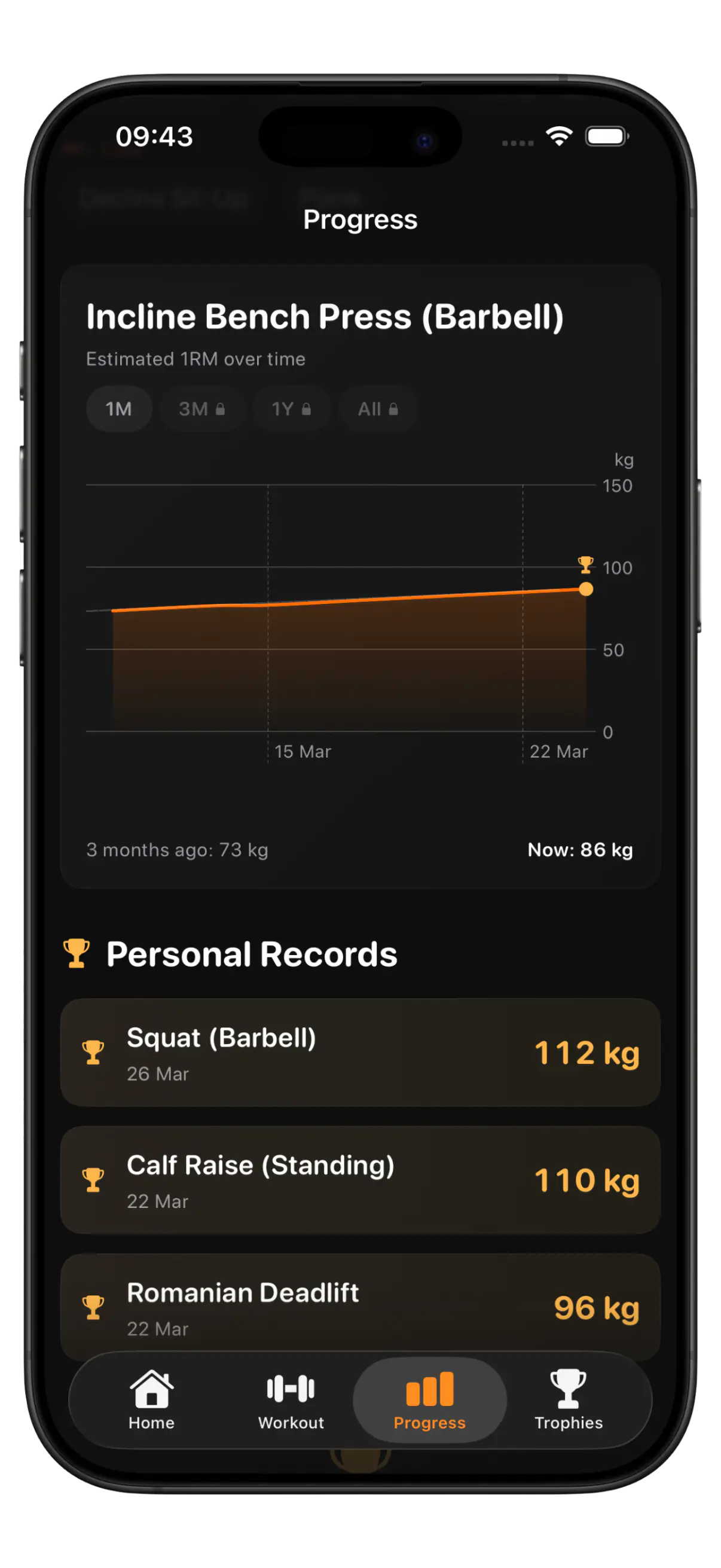
2. Trend visibility. Session-to-session progress is often too small to notice. But when you look at your estimated 1RM on a chart over three months, the trajectory becomes obvious. Are you progressing? Plateauing? Regressing? The trend line doesn't lie.
3. PR awareness. Knowing your personal records — both all-time and recent — gives you targets to chase. There's a specific motivational power in seeing "PR: 100 kg x 5" next to an exercise and thinking, "Today I'm going for 100 kg x 6." That's progressive overload distilled to its simplest form.
Apps built for gym tracking make this dramatically easier than notebooks or spreadsheets. IronStreak, for example, pre-fills every set with your numbers from last session and shows comparison arrows so you can see at a glance whether you're beating your previous performance. The Progress tab lets you track your estimated 1RM over time for every exercise, and the PR Board tracks your best lifts with actual dates. It turns the abstract concept of "progressive overload" into a concrete, visual system.
Whatever you use — a notebook, a spreadsheet, an app — the principle is the same: record everything, review before each session, and try to do a little more.
A Simple Progressive Overload Protocol
If you want a dead-simple system to follow, here it is:
- Pick your exercises. 4-6 per session is plenty — browse IronStreak's exercise library for ideas.
- Set a rep range. 6-8 for strength emphasis, 8-12 for hypertrophy, 12-15 for muscular endurance.
- Start at the bottom of the range. Use a weight you can handle with good form for the minimum reps.
- Add reps each session until you hit the top of the range for all sets.
- Increase the weight by the smallest available increment (1.25-2.5 kg upper body, 2.5-5 kg lower body).
- Drop back to the bottom of the rep range and repeat.
- Track everything. Every set, every rep, every weight.
- Deload every 4-6 weeks. Drop volume or intensity by 40-50% for one week to allow accumulated fatigue to dissipate.
This protocol works for beginners and intermediates alike. It's not fancy. It doesn't require periodization spreadsheets or percentage-based programming. It just requires consistency and tracking.
The Long Game
Progressive overload is a principle that works on every timescale. Session to session, week to week, month to month, year to year. The increments get smaller as you advance — a beginner might add 2.5 kg per week while an advanced lifter fights for 2.5 kg per month — but the principle never changes.
The lifters who are still getting stronger after 5, 10, 20 years of training are the ones who internalized this rule early: do a little more than last time, track it, and repeat. Everything else in fitness — exercise selection, rep schemes, training splits — is just details. Progressive overload is the engine.
Start tracking your lifts today. Know your numbers. Beat them by a little. Then do it again next week.
If you want a tracker that's built specifically around progressive overload — with last-session pre-fill, 1RM trend charts, and a PR Board that tracks your bests across every exercise — check out IronStreak — a free workout tracker on iOS.
Frequently Asked Questions
What is progressive overload?
Progressive overload is the principle that your training stimulus must gradually increase over time — more weight, more reps, more sets, better form, or shorter rest — for your muscles to keep adapting. It's the only training principle backed by every meta-analysis in strength and hypertrophy research. Without it, you're just exercising, not training.
How fast should I add weight?
Depends on training age. True beginners can add 2.5-5 lbs (1-2.5 kg) to most lifts every session for the first 3-6 months. Intermediate lifters progress weekly or bi-weekly at the same increment. Advanced lifters progress monthly. If you're stuck at the same weight for 3+ weeks, try adding reps instead: aim for +1 rep at the same weight next session, then consolidate before adding weight.
What if I can't progressive overload every week?
That's normal after the beginner phase. Use the 4 levers: add weight, add reps, add sets, or improve execution (slower tempo, better form, less rest). Tracking every set in an app makes micro-progress visible — even 1 extra rep at the same weight is progression. Plateaus longer than 4-6 weeks usually mean undereating, insufficient recovery, or programming issues — not a training problem.
Does progressive overload apply to bodyweight exercises?
Yes — four approaches: (1) add reps (classic progressive overload); (2) add difficulty (e.g., archer push-ups → one-arm push-ups); (3) add tempo (3-second lowering phase); (4) add weight via a weight belt or weighted vest. Pull-ups famously follow this pattern: 5 reps → 10 reps → weighted pull-ups with +10 lbs → etc.
Can I apply progressive overload without an app?
Yes, but it's harder. Without tracking, you're relying on memory, and memory consistently overestimates last session's performance. A notebook works. A spreadsheet works better. A dedicated workout app is best because it shows you last session's numbers inline during your next session — removing the guesswork. IronStreak pre-fills last session's data with 'beat last session' indicators.