A lasting gym streak is built by making attendance visible, starting at a frequency you can sustain (3x/week for most people), using freeze days for planned rest, and celebrating milestones — not outcomes. The underlying psychology is loss aversion (Kahneman/Tversky Prospect Theory) combined with the Seinfeld "don't break the chain" method. This guide covers the 5 practical tactics that actually work long-term.
Most gym memberships go unused within 90 days of signing up. According to the International Health, Racquet & Sportsclub Association, roughly 50% of new gym members quit within the first six months. The treadmills empty out by March. The squat racks thin out by April. By summer, most resolutions are distant memories.
But some people never quit. They train three, four, five times a week for years on end. They don't have superhuman willpower. They don't love every single workout. What they have is a streak — and streaks change everything.
In this guide, we'll break down why streaks are so effective for gym consistency, the psychology that makes them work, and five practical strategies to build a gym streak that actually sticks.
Why Streaks Work: The Psychology of Not Wanting to Lose
Behavioral economists have studied a phenomenon called loss aversion — the idea that losing something feels roughly twice as painful as gaining something of equal value. Nobel laureate Daniel Kahneman and Amos Tversky first documented this in their 1979 Prospect Theory paper, and it has been replicated in hundreds of studies since.
When you have a gym streak going — say, 14 consecutive weeks of hitting your workout target — the thought of breaking it feels genuinely painful. You're not just skipping a workout; you're losing 14 weeks of built-up momentum. That psychological weight is exactly what makes streaks so powerful. They turn every workout into a choice between "keep the chain going" and "start over from zero."
This connects to another well-documented principle: the endowment effect. Once we feel ownership over something — a streak, a record, a title — we value it more than we would if we didn't have it yet. A 30-day streak isn't just a number. It's yours, and you'll fight to protect it.
The Seinfeld Strategy: Don't Break the Chain
Jerry Seinfeld famously described his approach to writing comedy. He hung a large wall calendar and marked a red X on every day he wrote new material. After a few days, a chain formed. His only rule: don't break the chain.
The system works because it shifts your focus from outcomes to process. You're not trying to write the perfect joke or hit a bench press PR. You're just trying to keep the chain alive. That reframe is subtle but powerful:
- Outcome goals ("I want to bench 225") create pressure and binary pass/fail situations.
- Process goals ("I will train 3 times this week") create momentum and are entirely within your control.
Applied to the gym, the chain method means you stop thinking about whether today's workout will be amazing. You just need to show up, do the work, and mark the X. Over time, the chain becomes its own motivation.
5 Practical Tips for Building a Lasting Gym Streak
1. Start Smaller Than You Think
The most common mistake is setting an aggressive target right out of the gate. Six days a week. Two hours per session. Full PPL split with accessories. It works for about three weeks, then life intervenes — a late meeting, a bad night of sleep, a social obligation — and the whole system collapses.
Instead, start with two or three days per week. Research published in the British Journal of Sports Medicine consistently shows that training frequency matters less than total weekly volume and effort. Three well-executed sessions per week will deliver excellent results for most people, especially beginners.
Once three days feels automatic — something you do without negotiation — then consider adding a fourth. Build the habit before you build the volume.
2. Schedule Workouts Like Appointments
"I'll go when I have time" is the most dangerous sentence in fitness. If you don't schedule it, you'll always find a reason to postpone.
Block your workout times in your calendar the same way you'd block a work meeting or a doctor's appointment. Treat them as non-negotiable. Research from the European Journal of Social Psychology found that habit formation takes an average of 66 days — but only when the behavior is tied to a consistent cue (like a specific time and place).
Monday, Wednesday, Friday at 7 AM. Tuesday and Thursday at lunch. Saturday morning before errands. Pick your slots, protect them, and show up.
3. Use a Visual Streak Tracker
The Seinfeld chain works because it's visible. You see the streak every day. It's a constant, quiet reminder of how far you've come and what you'd lose by skipping.
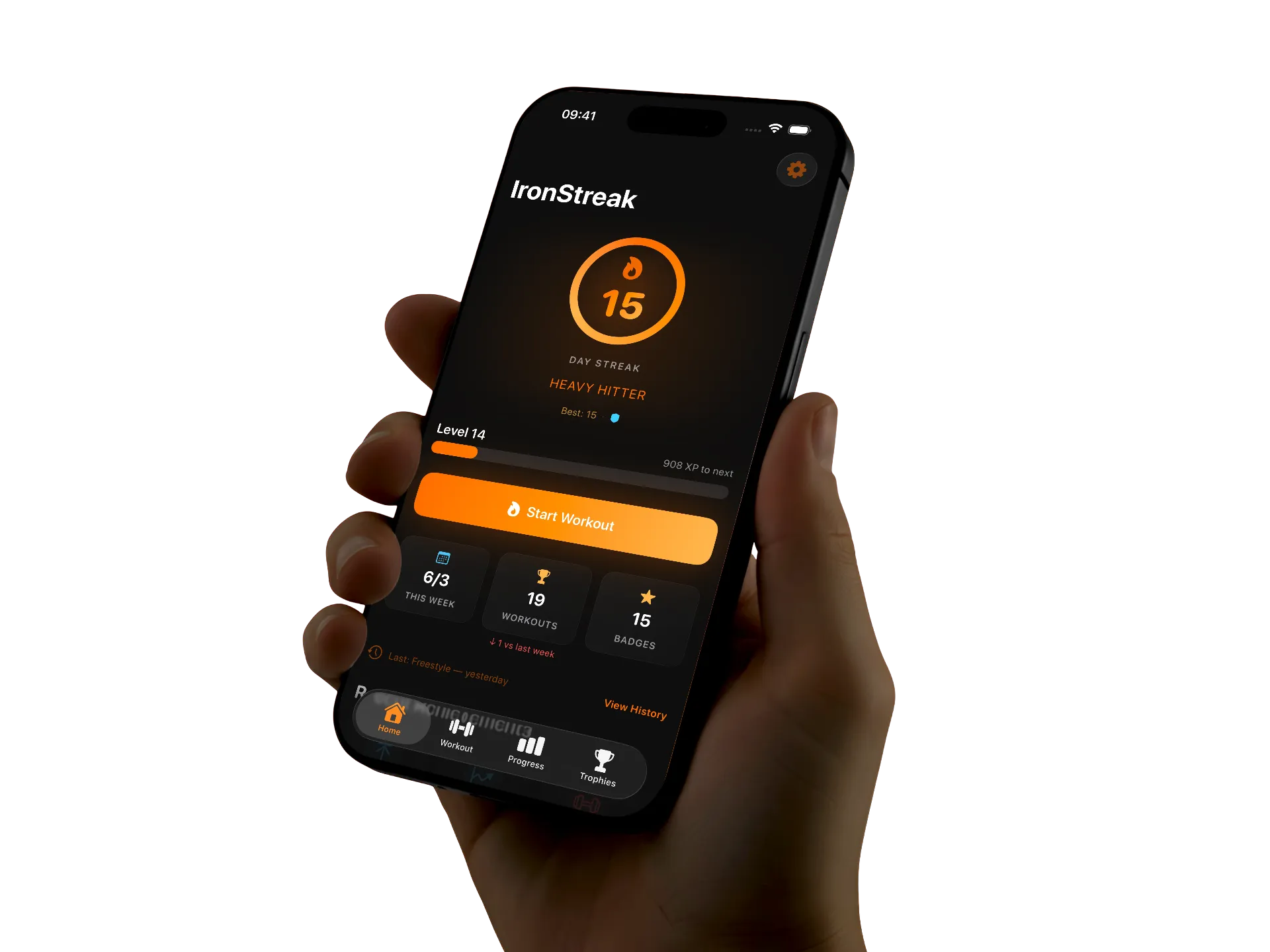
Digital streak trackers take this further by adding data to the visual cue. IronStreak's streak system, for example, displays a streak ring right on the home screen — a glowing circle that fills up as you hit your weekly workout target. It's the first thing you see when you open the app, and it's designed to trigger that loss-aversion response: the ring is full, the streak is alive, do you really want to reset it?
Whatever tool you use — a wall calendar, a spreadsheet, an app — make the streak visible. Don't let it hide in a menu or a tab you never check. Put it front and center.
4. Build in Streak Freezes for Rest and Recovery
Here's where most streak systems fall apart: they're too rigid. Life happens. You get sick. You travel. You have a rest week built into your program. A streak that breaks every time you take a planned rest day isn't a motivational tool — it's a source of guilt.
Smart streak systems include freeze days — the ability to pause your streak without resetting it. Think of it like Duolingo's streak freezes, but for the gym. IronStreak includes this feature specifically because the team recognized that punishing rest and recovery defeats the purpose. Rest is part of training. Your streak system should reflect that.
The key is setting rules for yourself: freezes are for legitimate rest, illness, or travel — not for "I didn't feel like it." One or two freezes per week is reasonable. More than that, and you're probably setting your weekly target too high (see tip #1).
5. Celebrate Milestones, Not Just Outcomes
Most people only celebrate body composition changes or PR lifts. Those are important, but they're slow and unpredictable. You might train perfectly for six weeks and not see visible changes in the mirror. If celebration is tied only to outcomes, motivation dries up fast.
Streaks give you something to celebrate every single week. Hit your target three weeks in a row? That's worth acknowledging. Reach a 30-day streak? That's a legitimate accomplishment. Make it to 100 days? You've fundamentally changed your relationship with exercise.
Some people use reward systems — a new piece of gym gear at 30 days, a nice dinner at 90. Apps like IronStreak gamify this with achievement badges across multiple categories: streak milestones, total workouts, volume records, and progressive overload. The trophy tiers (Bronze, Silver, Gold, Platinum) create natural celebration points that keep you chasing the next unlock. However you do it, mark the milestones. They matter more than you think.
The Compound Effect: Why Consistency Beats Intensity
There's a famous thought experiment: would you rather have $1 million right now, or a penny that doubles every day for 30 days? The penny seems absurd — until you do the math. After 30 days of doubling, that penny is worth over $5 million.
Fitness works the same way. A single incredible workout does almost nothing for your long-term progress. But 150 decent workouts stacked back-to-back over a year will completely transform your body, your strength, and your health.
The math is simple:
- 3 workouts/week x 50 weeks = 150 sessions per year.
- At an average of 45 minutes each, that's 112 hours of training.
- 112 hours of progressive, tracked work will take almost anyone from untrained to genuinely fit.
The people who look like they've been training forever don't have a secret program. They have a streak. They've been showing up consistently for years, doing the basics, adding a little weight or a few reps each time. The compound effect handles the rest.
Start Your Streak Today
Building a gym streak isn't about white-knuckling through brutal workouts or never missing a single day. It's about setting a realistic target, showing up consistently, tracking your progress, forgiving yourself when life gets in the way, and celebrating the milestones along the route.
Start with a number you can hit without heroics. Track it visually. Use freezes when you need them. Celebrate the streaks — not just the PRs.
If you're looking for a workout tracker that's built around streaks and gamification, IronStreak was designed from the ground up for exactly this — and it's free to download. It combines serious gym tracking (91 built-in exercises, progressive overload charts, PR tracking) with the motivational systems — streaks, XP, levels, achievements — that make consistency feel like a game worth winning.
Your first streak starts with your next workout. Make it count.
Frequently Asked Questions
What counts as a gym streak?
A gym streak is an unbroken sequence of weeks in which you've hit your target workout frequency. Most apps (including IronStreak) count weekly streaks: if your target is 3x/week and you hit 3+ workouts Monday through Sunday, the streak extends by 1. Daily streaks work for cardio but don't suit strength training (you need rest days). Weekly streaks reflect how real lifting programs are structured.
How long until a gym streak feels automatic?
A 2010 study in the European Journal of Social Psychology by Lally et al. found new behaviors take an average of 66 days to become automatic, with a range from 18 to 254 days. Gym attendance falls on the harder end because it involves travel, changing clothes, and physical effort. Most lifters report the gym feels 'normal' around week 8-12 of consistent attendance.
Does missing one day break a gym streak?
Depends on the streak type. Weekly streaks (most common) only break if you fail to hit your weekly target — one missed day is fine if you make it up. Daily streaks break on any missed day. IronStreak uses weekly streaks with freeze days for legitimate rest (illness, travel, planned deloads) so life doesn't destroy your hard-earned consistency.
What is a streak freeze?
A streak freeze is a mechanic (borrowed from Duolingo) that pauses your streak for a legitimate reason — illness, travel, planned rest week — without resetting it. IronStreak includes freeze days in the free tier. The rule: use them for real disruptions, not just days you don't feel like training. Excessive freeze use is a sign your target is set too high.
How do I restart after breaking my streak?
Don't overthink it. The longest streak you'll ever have starts with workout #1 after the break. Schedule your next session now. The behavioral trap is 'I'll start Monday' — which becomes 'I'll start next Monday.' Research shows the longer you delay the restart, the less likely it becomes. Start today, even if the workout is minimal. A 20-minute session rebuilds the habit infrastructure faster than a planned perfect session next week.