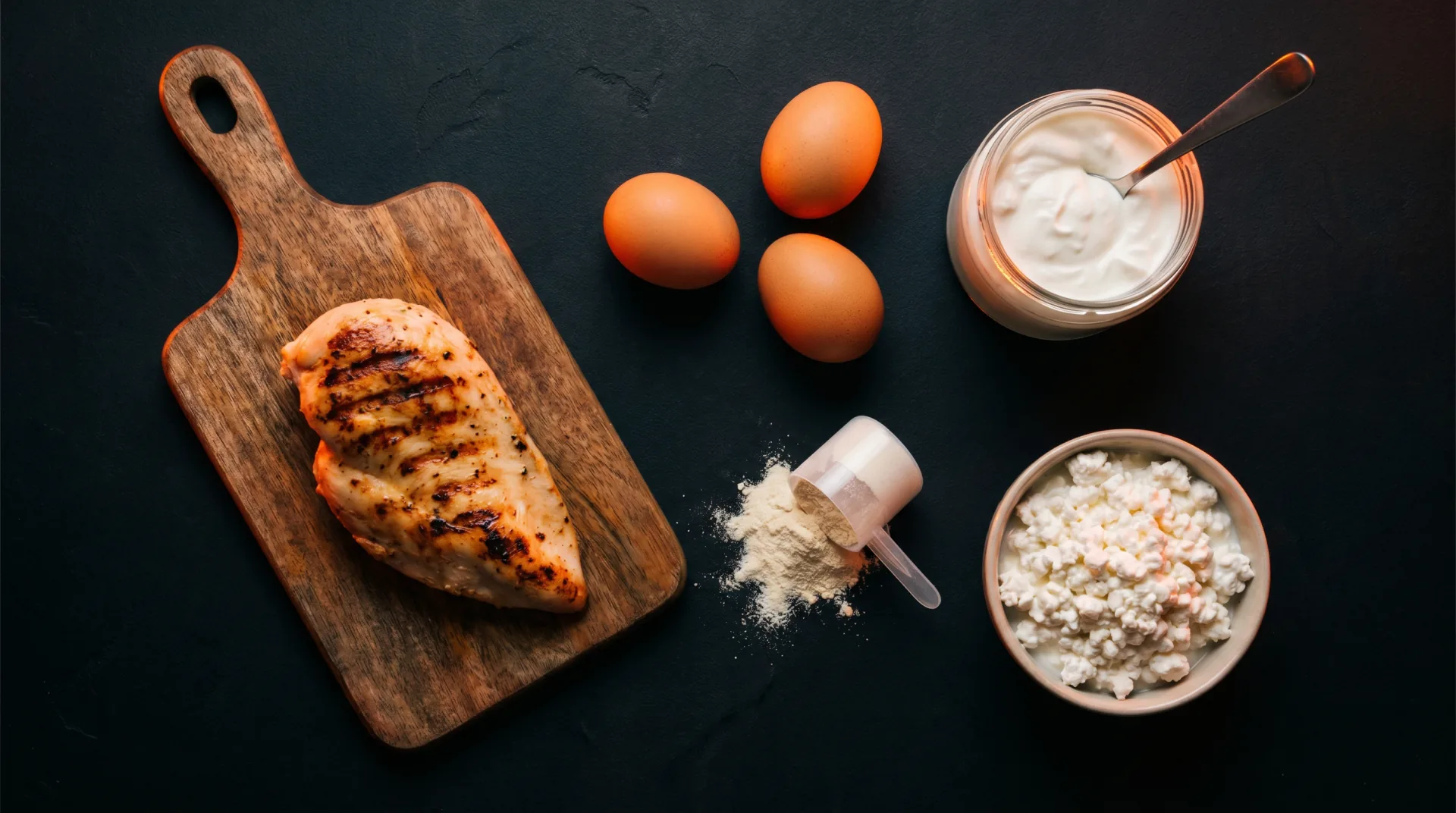
To build muscle, eat 1.6 to 2.2 grams of protein per kilogram of bodyweight per day (0.73 to 1.0 g per pound). Spread that total across 3 to 5 meals of 20-40 grams each. Total daily intake matters more than timing. For an 80 kg (176 lb) lifter that's 128-176 g per day — roughly a chicken breast, three eggs, a scoop of whey, and two Greek yogurts. This range comes directly from the 2017 International Society of Sports Nutrition position stand and was confirmed by the 2018 Morton et al. meta-analysis in the British Journal of Sports Medicine. Below that range, you leave growth on the table. Above 2.2 g/kg, additional protein provides no further muscle-building benefit for healthy adults.
Protein is the single most-studied variable in muscle-building nutrition, and the answer to "how much" has been settled science for nearly a decade. What's still confusing is how the media reports it — bodybuilding magazines push 400g days, cardio-focused articles push 60g days, and neither reflects what the evidence actually shows.
The Evidence-Based Range: 1.6-2.2 g/kg
The 2017 ISSN position stand on protein and exercise, authored by Jäger and 12 co-authors across the sports nutrition field, recommends 1.4-2.0 g/kg bodyweight per day for individuals doing resistance training, with 1.6-2.2 g/kg being the optimal range for maximizing muscle protein synthesis during a hypertrophy phase.
The 2018 meta-analysis by Morton, Murphy, McKellar and colleagues — published in the British Journal of Sports Medicine — pooled 49 studies with 1,863 participants and found that protein supplementation increased resistance-training-induced gains in muscle mass and strength, with a plateau around 1.62 g/kg. Above that threshold, additional protein yielded no statistically significant further gains for the average trained individual.
Translated to practical targets:
- 60 kg (132 lb): 96-132 g protein per day
- 70 kg (154 lb): 112-154 g per day
- 80 kg (176 lb): 128-176 g per day
- 90 kg (198 lb): 144-198 g per day
- 100 kg (220 lb): 160-220 g per day
For an exact number matched to your bodyweight, training volume, and goal (cut vs. maintain vs. bulk), use our free macro calculator — it plugs into the ISSN range automatically.
Why 1 g/lb Became the Standard Recommendation
The old bodybuilding-gym advice of "one gram per pound" (2.2 g/kg) sits at the top of the evidence-based range. It's not harmful; it's simply the ceiling above which additional protein does not produce extra muscle growth for most people. The reason it became the common rule of thumb is that it's easy to remember and errs on the generous side — useful insurance if you're unsure about absorption, food logging accuracy, or training stress.
The practical takeaway: 1.6 g/kg is the minimum effective dose; 2.2 g/kg is the ceiling. Anywhere in that range is optimal. If you're at 1.0 g/kg, increasing to 1.6 g/kg will produce measurable gains. If you're at 1.8 g/kg and adding another 50 g per day, you're just making meal planning harder.
Per-Meal Distribution: 20-40 g Spread Across 3-5 Meals
Total daily intake is the priority, but how you spread protein across meals affects muscle protein synthesis (MPS) over the day.
A 2015 study by Morton and colleagues in the American Journal of Physiology established that MPS is maximally stimulated by about 0.4 g/kg of high-quality protein per meal. For a 75 kg person, that's roughly 30 g. For an 88 kg person, 35 g. Additional protein in a single meal beyond this threshold is still used (for energy, other tissues, or later amino acid storage), but it does not further increase muscle synthesis in that window.
Practical meal structure:
- 3 meals per day: 35-50 g protein each. Works for simpler lifestyles and intermittent-fasting styles.
- 4 meals per day: 30-40 g each. The most common effective setup.
- 5 meals per day: 25-35 g each. Useful for high-protein-target athletes (2.0+ g/kg) who struggle to hit the number in fewer meals.
Eating 15 g at breakfast, 15 g at lunch, and 150 g at dinner still stimulates MPS, but not as efficiently as three balanced 60 g meals. If you're doing hard resistance training, the small protocol detail of splitting meals is worth the 15 minutes of planning.
The Best Protein Sources
A "complete protein" contains all 9 essential amino acids. Animal proteins are complete by default. Most plant proteins are incomplete but easily combined.
Complete Animal Proteins (per 100 g cooked, approximate)
- Chicken breast: 31 g protein, 165 kcal
- Lean beef (90% lean): 26 g, 217 kcal
- Pork tenderloin: 26 g, 143 kcal
- Salmon: 25 g, 208 kcal
- Tuna (canned in water): 26 g, 116 kcal
- Eggs: 13 g per 100 g (~2 large eggs), 155 kcal
- Whey protein isolate: 90 g per 100 g powder (a 30 g scoop = 27 g protein)
- Greek yogurt (non-fat): 10 g, 59 kcal
- Cottage cheese (low-fat): 11 g, 81 kcal
Complete Plant Proteins
- Tofu (firm): 17 g per 100 g, 144 kcal
- Tempeh: 20 g per 100 g, 195 kcal
- Soy protein isolate: 90 g per 100 g powder
- Quinoa (cooked): 4 g per 100 g, 120 kcal
Other plant sources like rice, beans, oats, and nuts are incomplete individually but combine to provide all essential amino acids. Rice + beans is the classic complementary pair. If you're vegan or vegetarian and serious about muscle growth, a 2021 Journal of the ISSN study found no difference in muscle gains between whey and soy protein at matched total intake — but you may need to eat slightly more total protein (2.0-2.4 g/kg vs 1.6-2.2) to compensate for slightly lower leucine content in most plant sources.
The Anabolic Window Is Wider Than You Think
The myth: you must drink a protein shake within 30 minutes of training or your session is wasted. The evidence: the anabolic window is 4-6 hours wide, and total daily intake is what drives long-term growth.
A 2013 meta-analysis by Aragon and Schoenfeld in the Journal of the International Society of Sports Nutrition examined post-workout protein timing across 23 studies. Their conclusion: timing effects are real but small, and completely swamped by total daily protein intake. If you've eaten a protein-rich meal within 2-3 hours pre-workout, you have 4-6 hours post-workout to hit your next meal without losing anything meaningful.
Practical implication: don't skip workouts because you forgot your shake. Don't panic about hitting a 30-minute window. Do make sure your full day's protein total is on target.
Protein on a Cut vs. a Bulk
During a calorie deficit (weight loss), protein intake becomes more important, not less. A 2016 study by Longland and colleagues showed that subjects in a severe deficit (40% below maintenance) preserved more muscle and lost more fat eating 2.4 g/kg vs. 1.2 g/kg.
- Maintenance (body-recomp, maintenance phase): 1.6-2.0 g/kg
- Cutting (fat loss while preserving muscle): 2.0-2.4 g/kg
- Bulking (gaining weight): 1.6-2.0 g/kg is sufficient; calories matter more here
During a cut, protein also has the highest thermic effect of food (20-30% of calories used in digestion) and the highest satiety per calorie — making a high-protein diet easier to sustain at a deficit.
Is Too Much Protein Bad for You?
For healthy individuals, no. A 2018 systematic review in Journal of Nutrition and Metabolism concluded that protein intakes up to 2-3 g/kg showed no adverse kidney or bone effects in people with healthy kidney function. The kidney-damage myth originates from advice given to patients with pre-existing chronic kidney disease — extrapolating that advice to healthy adults is a medical category error.
If you have diagnosed kidney disease, diabetes-related kidney issues, or are pregnant, consult your physician. Otherwise, the evidence supports long-term intakes up to 2.2 g/kg as entirely safe.
How IronStreak Supports Your Protein Goals
Our free macro calculator uses Mifflin-St Jeor for BMR and the ISSN position stand for protein targeting. Enter your stats, pick your goal (cut / maintain / bulk), and get an exact protein target plus recommended carbs and fats. No sign-up required.
IronStreak the app doesn't track nutrition yet (we focus on workout logging, streaks, and progressive overload), but the tools section includes the macro calculator alongside 1RM, training volume, plate, and strength standards calculators — everything you need to program your training and your nutrition around it.
FAQ
How much protein do I need to build muscle?
1.6-2.2 g/kg bodyweight per day (0.73-1.0 g/lb). For an 80 kg lifter: 128-176 g. Source: ISSN 2017 position stand, confirmed by Morton et al. 2018 meta-analysis.
Is 1 g/lb of protein enough?
Yes — 1 g/lb (2.2 g/kg) is at the top of the evidence-based range. No additional benefit above this for muscle growth.
How much protein per meal?
20-40 g per meal, 3-5 meals per day. MPS plateaus around 0.4 g/kg per meal (about 30 g for a 75 kg person).
What are the best protein sources?
Chicken breast, lean beef, eggs, whey protein, Greek yogurt, cottage cheese, tofu, tempeh, soy protein. Vary sources; plant-eaters aim slightly higher total (2.0-2.4 g/kg).
Do I need protein immediately after training?
No. The anabolic window is 4-6 hours. Total daily intake drives growth; precise timing is minor.
Can you build muscle without meat?
Yes. 2021 ISSN study found no difference between whey and soy at matched intake. Plant-based lifters just need varied sources and may need slightly higher total protein.
Is too much protein bad for kidneys?
Not for healthy people. Intakes up to 2-3 g/kg show no kidney effects in healthy adults. The myth comes from advice given to patients with existing kidney disease.
Key Takeaways
- Target 1.6-2.2 g/kg bodyweight per day (0.73-1.0 g/lb). Optimal range per ISSN 2017 + Morton 2018.
- Spread across 3-5 meals of 20-40 g each. MPS plateaus around 0.4 g/kg per meal.
- Complete proteins: chicken, beef, eggs, dairy, fish, whey, soy, tempeh. Plant-based works — just vary sources.
- Anabolic window is 4-6 hours. Total daily intake matters more than timing.
- On a cut: 2.0-2.4 g/kg preserves muscle and fills you up. On a bulk: 1.6-2.0 g/kg is sufficient.
- Not harmful for healthy kidneys at any evidence-based intake.