The most reliable way to stay consistent at the gym is to stop relying on motivation and start relying on systems. The people who train for years don't have more willpower than you do — they've built four specific levers that make showing up easier than skipping: a clear athletic identity, a low-friction environment, a repeatable system, and visible accountability. This guide covers each one with the underlying behavioral science and exactly how to apply it.
Roughly 50% of new gym memberships go unused within six months, according to the International Health, Racquet & Sportsclub Association. The people who stick aren't genetically gifted or uniquely disciplined. They've just stumbled into — or deliberately engineered — a structure that removes the daily decision of whether to train. This is the architecture of that structure.

Why Motivation Always Fails
Motivation is an emotional state, and emotional states are volatile. They rise and fall with sleep, stress, hormones, weather, and social context. Neuroscience research published in Nature Reviews Neuroscience shows dopamine — the neurotransmitter most associated with motivation — fluctuates dramatically within a single day, let alone across weeks.
This is why people who only train when they "feel like it" train about twice a month. They're not lazy. They're just waiting for a mental state that only shows up 10–15% of the time. Consistency isn't built on feelings; it's built on defaults.
The goal of this framework is to make going to the gym the path of least resistance — so on the 85% of days when motivation is average or low, you still end up there.
Lever 1: Identity — Become a Lifter, Not Someone Who Lifts
Behavioral psychologist James Clear wrote in Atomic Habits that "every action you take is a vote for the type of person you wish to become." This isn't just a nice quote — it's a well-documented mechanism. A 2009 study in the Journal of Consumer Research by Bryan et al. found that people who described themselves as "a voter" (identity) voted 13% more often than those who described themselves as "voting" (action). The framing alone shifted behavior.
Apply this to the gym:
- Weak identity: "I'm trying to get in shape." (goal, impermanent)
- Strong identity: "I'm a lifter." (identity, stable across missed workouts)
When you miss a workout as a "lifter," you don't quit — you just show up tomorrow because that's what lifters do. The identity survives the lapse. A goal doesn't; a missed day of a 30-day challenge is a failure, but a missed day of a lifetime of lifting is a Tuesday.
How to apply: Stop saying "I'm trying to work out more." Start saying "I train." Then prove it by showing up twice this week. Identity follows action, then reinforces it.
Lever 2: Environment — Design for the Default
Wendy Wood's research at USC, summarized in her book Good Habits, Bad Habits, found that roughly 43% of daily actions are performed in the same location at the same time — almost entirely driven by environmental cues, not conscious choice. If you want to make the gym automatic, you need to encode it into your environment.
Four environmental shifts that measurably improve consistency:
- Pick a gym within 12 minutes of your home or office. A 2013 study in Health & Place found attendance drops by more than 50% when the commute exceeds this threshold. Proximity beats amenities.
- Lay out your gym clothes the night before. Tiny friction compounds. Removing the "find the shorts" step at 6 AM raises morning workout probability by a surprising margin.
- Pre-commit the workout. Open your tracking app the night before and load tomorrow's session. This is an implementation intention — a technique shown in meta-analyses to roughly double the probability of a planned behavior occurring.
- Remove exit ramps. Don't route through the couch on the way to the gym. Don't check email before leaving. Make the only easy path the one that ends with you under the bar.
The principle: If you have to think, you've already lost. Design your environment so the gym is the default and skipping takes active effort.
Lever 3: System — The Four Building Blocks
A gym system has four components. Miss any one and consistency starts leaking.
1. A Fixed Schedule
Three days per week, same days, same time. Monday/Wednesday/Friday at 7 AM. Tuesday/Thursday/Saturday at lunch. Pick your slots and defend them like dentist appointments. Variable schedules destroy habit formation because the brain never gets a consistent cue to lock onto.
2. A Written Program
Don't walk in wondering what to do. That's where decision fatigue kills workouts. Follow a written program — Push Pull Legs, upper/lower, 5x5, whatever fits your frequency. The program removes 20 decisions per session and replaces them with one: show up.
3. Progressive Overload Tracking
Progressive overload is the only principle that drives long-term strength gains. Without it, you're just exercising. Tracking every set with weight and reps lets you aim for one more rep or 2.5 more kilograms each session. That tiny weekly progress is what keeps the gym interesting past month three.
4. Defined Done
Know when the workout is over before it starts. Four exercises, three sets each, go home. Open-ended sessions invite negotiation ("I'll stop after one more"), which invites skipping ("I'll do it tomorrow instead"). A bounded session is a finishable session.
Lever 4: Accountability — Make the Streak Visible
Self-monitoring is one of the most predictive variables of long-term exercise adherence, according to research in the Journal of Behavioral Medicine. The mechanism is two-fold: visible progress triggers the dopamine hit of achievement, and a visible streak triggers loss aversion when skipping.
Loss aversion, documented by Kahneman and Tversky's Prospect Theory, means losing something feels about twice as painful as gaining something of equal value. A 42-day streak isn't just a number — it's property you don't want to lose.
This is the most under-used lever in gym consistency. Most people track workouts in their head or in a notes app they forget about. A visible streak system — a calendar marked with X's, an app that shows a glowing ring — converts abstract consistency into a concrete thing you can defend.
How IronStreak Applies This Framework
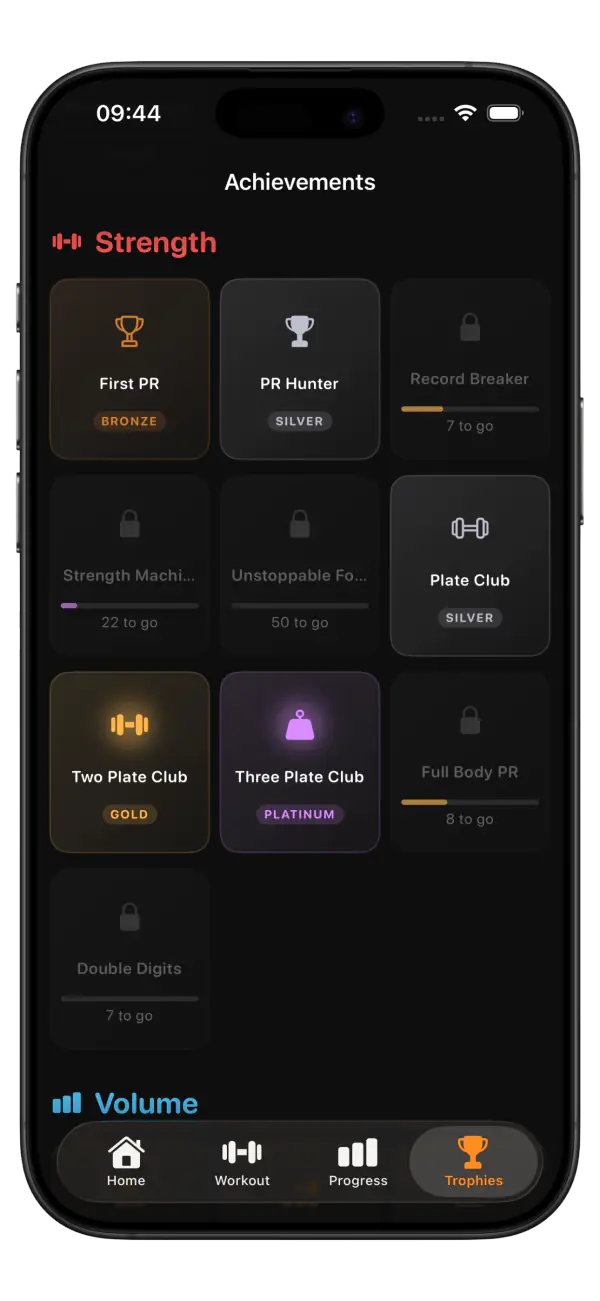
Everything in this article is design philosophy baked into IronStreak from day one. The streak ring on the home screen makes accountability visible every time you open the app. Pre-filled last-session data removes friction when starting a workout. XP and achievements trigger identity reinforcement — every unlocked trophy is evidence of the lifter you're becoming. Streak freezes acknowledge that rest and travel are part of training, not failure.
It's deliberately designed like a game because games are the most thoroughly studied systems for sustaining daily behavior. The same mechanics that keep people logging into Duolingo for 1,000+ days translate directly to the gym — if you wire them to real progress instead of fake rewards.
The 90-Day Consistency Plan
Consistency is a skill, and like any skill it has a learning curve. Here's how the four levers unfold across the first 90 days:
- Days 1–14: Establish schedule and environment. Train 3x per week no matter what the workout looks like. Quality doesn't matter yet — presence does.
- Days 15–45: Lock in identity. Start tracking every set. Watch the streak build. Resist the urge to increase frequency — protect what's working.
- Days 46–75: Progressive overload becomes the main game. You'll start seeing real strength gains. The gym becomes something you notice you want to do on off days.
- Days 76–90: The habit is essentially wired. Skipping feels wrong. You can now start adding volume, a fourth day, or more advanced programming — because the foundation can handle it.
FAQ
How long does it take to build a gym habit?
A 2010 study in the European Journal of Social Psychology by Lally et al. found it takes an average of 66 days for a new behavior to become automatic, with a range from 18 to 254 days. Going to the gym falls on the harder end because it involves travel, changing clothes, and physical discomfort. Expect 60 to 90 days before your routine feels like default behavior rather than a decision.
Why do I keep losing motivation to work out?
Motivation fails because it's an emotion, not a system. Neuroscience research shows motivation fluctuates with sleep, stress, and dopamine baseline. Consistent gym-goers don't have more motivation — they rely less on it. They've built identity, environment, and tracking systems that reduce the decision cost of showing up.
Is it better to work out at the same time every day?
Yes, strongly. Habit research by Wendy Wood at USC shows behaviors tied to consistent time-and-place cues become automatic faster than variable-schedule behaviors. Morning workouts tend to stick best because fewer competing demands exist before 9 AM, but the specific time matters less than the consistency.
How many times per week should I go to the gym to be consistent?
Three days per week is the optimal starting frequency. Meta-analyses in Sports Medicine show that 3–4 sessions per week produces roughly 90% of the hypertrophy benefits of 5–6 sessions, at much lower dropout risk. Start at three, earn the right to four once three feels automatic.
What's the difference between motivation and discipline?
Motivation is the feeling of wanting to act. Discipline is a system that makes acting easier than not acting. The most consistent lifters aren't more disciplined in a willpower sense — they've just designed their lives so the default path leads to the gym.
Should I track my workouts to stay consistent?
Yes. Self-monitoring is one of the strongest predictors of long-term exercise adherence. An app that shows your streak, logs your sets, and pre-fills your last session removes friction and adds accountability — both critical during the 60–90 day window when habits are still forming.
Key Takeaways
- Motivation is unreliable. Systems aren't. Build identity, environment, process, and accountability.
- Three days per week is enough. Don't start bigger until the three feels automatic.
- Environment is doing most of the work in consistent people's lives. Make the gym the default path.
- A visible streak leverages loss aversion — arguably the most powerful behavioral lever available to gym-goers.
- Expect 60–90 days before consistency feels effortless. Protect that window.