A strong, shoulder-safe overhead press comes down to eight cues: grip just outside shoulder-width, rack the bar on your front delts with elbows forward, brace your whole body, pull your head back before pressing, drive the bar in a straight vertical line, use a controlled layback to keep that line true, lock out with active shoulders, and control the descent back to the rack. Miss any of them and you're either pressing forward instead of up, leaking force through a loose torso, or risking your rotator cuff at lockout. This guide covers each cue with the anatomy behind it, the most common mistakes, and fixes.
The strict press is the purest test of upper-body strength. Bench press recruits the whole pec shelf and gets a rebound from the bench; overhead press gets no rebound, uses less muscle, and exposes every weakness in your torso, shoulder mobility, and bracing. That's why it's the hardest of the big four barbell lifts — and why programming it well pays off for years. The cues below are consistent with IPF-adjacent strict-press technique, Greg Nuckols' writing on overhead pressing, and Mark Rippetoe's Starting Strength coaching points.
The Rack Position Is Everything
More than any other lift, overhead press lives or dies at the bottom. A bad rack position means the bar starts forward of where it needs to be, the press has nowhere to go but forward, and your shoulder takes the load at every rep's worst angle. Spend time getting this right.
Cue 1 — Grip Just Outside Shoulder-Width
Wrap the bar with your thumbs, wrists stacked directly under the bar. Grip width: just outside shoulder-width. Narrow enough that when the bar is on your front delts, your forearms are vertical — not angled inward (too wide) or outward (too narrow).
Why it matters: A vertical forearm transmits force directly up. An angled forearm bleeds force sideways and loads your wrist. A bent-back wrist means the bar sits in your palm instead of stacked over the bone — that turns every heavy rep into a wrist injury waiting.
Common mistake: Gripping bench-press-wide. OHP grip is narrower than bench by a full hand width on most lifters.
Cue 2 — Rack on Front Delts, Elbows Forward
The bar sits on your clavicles and front delts, not up on your throat and not down at your sternum. Elbows point forward and slightly down — not flared out to the sides like a bench press.
Why it matters: Forward elbows put your forearms in a vertical line under the bar. Elbows flared out move the bar forward of that line and turn a press into an incline fly. A 2018 Journal of Strength and Conditioning Research analysis of overhead pressing mechanics found that elbow position at rack was the single strongest predictor of bar path deviation during the concentric phase.
Common mistake: Elbows flared 45° to the sides like a shoulder press machine. Tuck them forward so your upper arm is parallel to your torso.
Bracing and Setup
Cue 3 — Brace Head-to-Toe
Feet hip-to-shoulder-width. Squeeze glutes hard. Lock out your knees. Take a big breath into your belly — not your chest — and brace your core as if preparing to take a punch. Hold the brace for the entire rep.
Why it matters: Overhead press has no bench to help you. Your whole body is the platform. Loose glutes or unlocked knees mean your hips hinge backward every rep — the stability leak shows up as a bar path that wobbles left or right near lockout. Lock every joint from feet to chest before you press.
Cue 4 — Pull Your Head Back First
Before the bar moves, actively pull your head back. Tuck your chin and move your head straight backward about 2-3 inches — like avoiding a punch. This is not leaning back. You're clearing a vertical path for the bar to travel without hitting your face.
Why it matters: The bar must travel in a straight line over your mid-foot. Your face is in the way of that line. If you don't pull your head back, you're forced to press the bar forward around your face — that forward bar path is the #1 reason OHP plateaus and the #1 source of shoulder issues.
Common mistake: Keeping your head perfectly still and pressing around your face. The fix is an active chin-tuck and head-pull before the bar moves.
The Press
Cue 5 — Drive the Bar Straight Up
Press the bar in a vertical line directly over the middle of your foot. The bar should pass your face (which is now pulled back out of the way), and once the bar clears your forehead, your head pops forward under the bar to complete the lockout.
Bar path visualization: Imagine a string from the bar to your mid-foot. That string should stay perfectly vertical from start to finish. Any forward drift is weight lost.
Cue 6 — Controlled Layback, Not Back-Bend
At the start of the press, a 10-15° layback is legal in strict press (Olympic weightlifting rules, most powerlifting federations) and physically necessary to keep the bar path vertical. The layback is initiated from the glutes and abs, not by arching the lower back.
As the bar clears your face, you return to fully upright and complete the press. A layback that exceeds 15-20° or comes from lumbar extension becomes an incline bench press and loses the "strict" credit.
Why it matters: A perfectly vertical bar with zero layback means either the bar drifts forward (weight lost) or your trunk position collapses forward (shoulder at a bad angle). A controlled layback keeps both the bar and your torso in good positions.
Cue 7 — Lockout with Active Shoulders
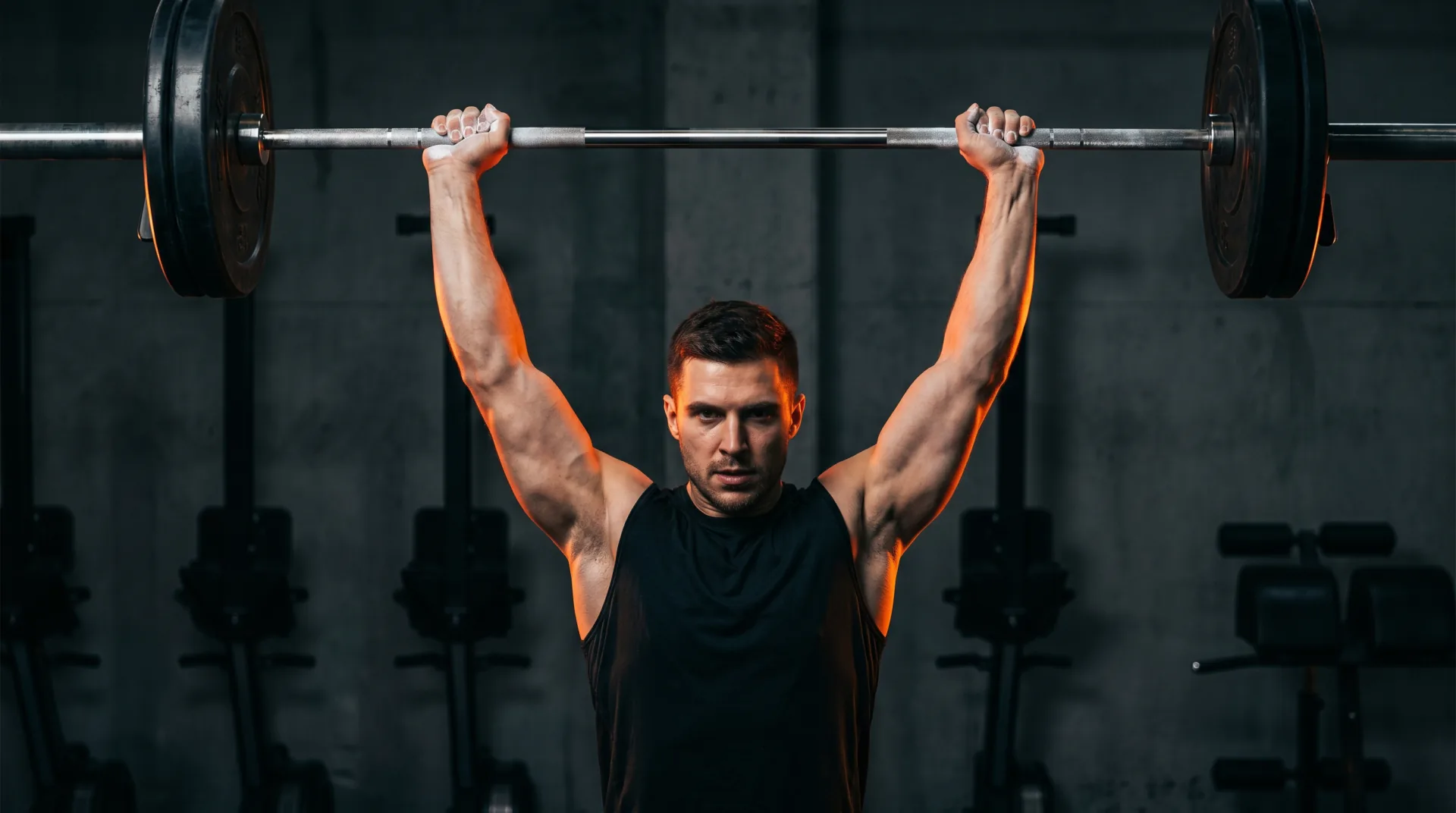
At the top: arms fully straight, biceps near your ears, shoulders shrugged up into the bar. Actively push the bar toward the ceiling at lockout. This is called the "active shoulder" position.
Why it matters: A passive lockout — bar held up but shoulders hanging in the joint — puts the rotator cuff in an impingement position under load. Active shoulders rotate the scapula up and back, clearing that impingement space. A 2012 study in Physical Therapy in Sport found athletes with active-scapula overhead positioning had 60% less subacromial impingement risk under heavy overhead loads.
Cue 8 — Control the Descent
Lower the bar back to the front rack under control — 2-3 seconds, matching the concentric. Re-rack cleanly on your front delts, re-brace, press again.
Why it matters: The eccentric phase trains muscle just as hard as the concentric and teaches your nervous system the exact bar path you want on the next rep. Letting the bar crash down is lost stimulus and worse technique every rep.
The 5 Most Common Overhead Press Mistakes
- Bar path drifts forward. Fix: actively pull head back before pressing so the bar can travel in a true vertical line past your face.
- Elbows flared out at rack. Fix: tuck elbows forward and slightly down, forearms vertical.
- Lumbar hyperextension (back-bend). Fix: glutes + abs tight, layback comes from mid-section, not low back.
- Passive lockout. Fix: actively shrug shoulders up into the bar at the top.
- Bent-back wrists. Fix: wrap the bar with a thumbless or thumbs-around grip, wrist stacked directly under bar.
Programming the Overhead Press
- Strength: 4-5 sets of 3-5 reps at 80-90% 1RM, once per week.
- Hypertrophy: 3-4 sets of 6-10 reps at 65-80% 1RM, 1-2x per week.
- Beginner: 3 sets of 5 reps. Add 1-2.5 kg (2.5-5 lb) per session until form breaks, then hold for a week. OHP progresses roughly half the speed of squat or bench.
OHP gains come slower than any other barbell lift. A 2.5 kg PR on overhead press is a real accomplishment — expect them every 2-4 weeks for beginners and every 2-3 months for intermediate lifters. Use the strength standards calculator to benchmark your numbers against novice/intermediate/advanced ratios, and check your estimated 1RM to set realistic training percentages.
How IronStreak Supports Your Overhead Press
IronStreak's shoulders exercise library includes barbell overhead press, dumbbell overhead press, Arnold press, landmine press, and more. Each exercise page includes form cues pulled straight from research — tap the (i) icon during any workout for instant mid-set form check.
Every set gets logged, estimated 1RM charts update in the Progress tab, and OHP PRs trigger a trophy celebration overlay. Want to track progressive overload across your strict press? IronStreak pre-fills every rep from last session so you always know exactly what to beat.
FAQ
What is proper overhead press form?
Grip just outside shoulder-width, bar racked on front delts with elbows forward, whole-body brace, chin tucked back before pressing, bar driven straight up over mid-foot, head pops forward under the bar at the top, lock out with active shoulders, controlled descent.
Is overhead press better than bench press?
Neither is "better" — they train different patterns. Bench for horizontal pushing, OHP for vertical. Do both. Most balanced programs: 2x bench, 1-2x OHP per week.
Why can I press so much less overhead than bench?
OHP uses less muscle and a longer range of motion. Typical ratio: OHP is 50-60% of bench. Bodyweight OHP = solid intermediate mark; 1.5x bodyweight = elite.
Is overhead press bad for shoulders?
No — with good form and adequate mobility, it's the best shoulder-health builder in the gym. Bad form or limited thoracic mobility is what causes issues, not the lift itself.
Push press vs strict press?
Both. Strict press for maximal shoulder strength. Push press (leg drive) for 15-20% more weight and explosive power. Alternate them or run them on different days.
How do I fix a forward bar path?
Pull your head back before pressing. The bar needs a straight vertical line over mid-foot — your face is in the way unless you clear it.
How often should I overhead press?
Once or twice per week. Two heavy sessions in one week is usually too much for the shoulder's recovery.
Key Takeaways
- Rack position dictates everything. Elbows forward, forearms vertical, wrists stacked.
- Pull your head back before pressing. The bar path must be vertical over mid-foot.
- Whole-body brace: glutes, abs, locked knees. Nothing leaks.
- A 10-15° layback from glutes/abs is legal and necessary. Back-arching from the lumbar is not.
- Lock out with active shoulders shrugged up into the bar. Never hang passively in the joint.
- Press 1-2x per week. Gains come slower than any other lift — track every set and celebrate 2.5 kg PRs.