A strong, safe bench press comes down to seven cues: plant your feet, grip slightly wider than shoulder-width, retract and depress your scapulae, create a slight arch, tuck your elbows to 45–75 degrees, lower the bar to mid-chest with control, and press up on a diagonal path toward your face. Miss any of them and you're either leaving strength on the table or wrecking your shoulders. This guide covers each cue with the anatomy behind it, the most common mistakes, and exactly how to fix them.
The bench press is the most-searched lift on Earth for a reason — it's also the most miscoached. Half the form advice on TikTok is actively dangerous. The cues below are consistent with powerlifting federation technique, sports-science literature, and the programming used by credible coaches like Jeff Nippard, Mike Israetel, and Greg Nuckols.
Before You Press: The Setup Is Half the Lift
Most bench press failures happen before the bar leaves the rack. Rushing the setup means pressing from a weak, unstable position — which reduces strength and increases injury risk. Slow down. The setup should take 15–30 seconds every rep.
Cue 1 — Plant Your Feet and Build Tension
Your feet are an underrated part of the bench press. Plant them flat on the floor, slightly wider than the bench, with your heels roughly under your knees or slightly behind. Push your feet into the ground as if you were trying to slide your body toward the rack.
Why it matters: Leg drive transfers force through your glutes and up your back into the bar. A 2014 study in the Journal of Strength and Conditioning Research found that active leg drive significantly increased bench press 1RM compared to passive leg positioning.
Common mistake: Feet up on the bench, or dangling. This destroys stability and can cut your press by 10–15%.
Cue 2 — Grip Slightly Wider Than Shoulder-Width
Set your hands so that at the bottom of the rep — with the bar touching your chest — your forearms are perfectly vertical. For most lifters, that's index fingers on the knurling rings or just inside them.
Why it matters: Vertical forearms minimize shear stress on the wrists and elbows and put the pressing muscles in their strongest leverage position. Too narrow shifts load onto the triceps and limits your chest's contribution; too wide increases shoulder strain and shortens range of motion.
Thumb rule: Always wrap your thumbs around the bar. The "suicide grip" (thumbless) has killed lifters. This is not hyperbole — look up Justin Jones-Fosu or several powerlifting accidents. Wrap your thumbs.
Cue 3 — Retract and Depress Your Scapulae
Once you're lying on the bench, pinch your shoulder blades together and pull them down toward your back pockets. This is the single most important cue for shoulder health on bench press.
Why it matters: Scapular retraction creates a stable "shelf" for the bar to sit on at the bottom of the rep. Without it, the shoulders rotate forward into a protracted position where the humerus impinges against the acromion — the mechanical cause of bench-press-related shoulder pain. A 2020 review in Sports Health identified scapular instability as the primary cause of pressing-related shoulder injuries.
Common mistake: Losing scapular retraction at the top of the rep. Your shoulder blades should stay pinched through every rep of every set — don't let them "release" at lockout.
Cue 4 — Create a Slight Arch and Unrack Carefully
With feet planted, scapulae retracted, and upper back tight, a small natural arch forms in your lower back. Keep your glutes on the bench — this isn't a powerlifting competition arch. The goal is a stable, strong pressing position, not maximum arch.
When unracking, pull the bar out of the hooks by pulling it toward your feet — don't press it up first. Pressing to unrack disrupts your scapular position and wastes energy.
Common mistake: Glutes lifting off the bench mid-rep. In most gyms this is fine; in powerlifting competitions it's a red-lighted lift. Either way, it usually indicates the setup is too loose.
The Press: Execution Cues
Cue 5 — Tuck Your Elbows to 45–75 Degrees
As you lower the bar, your elbows should travel at roughly 45 to 75 degrees from your torso — not flared out to 90. A good mental model: the path from your shoulder to your elbow should form an angle closer to an "A" than a "T" with your torso.
Why it matters: Elbows flared to 90 degrees place the shoulder joint in its weakest and most impingement-prone position. This is the single most common cause of bench-press-related shoulder pain and rotator cuff damage. A moderate elbow tuck keeps the humerus in a safer pressing arc while still loading the chest effectively.
Common mistake: Aggressive elbow flare for "chest activation." The chest doesn't need flared elbows to grow; it needs range of motion and progressive overload over time.
Cue 6 — Lower the Bar to Mid-Chest Under Control
The bar should touch down on your mid-chest or just below your nipples — not on your upper chest near the clavicles, and not down on your stomach. Lower it under control over 2–3 seconds. Stopping 1–2 inches short of the chest is a leak of range of motion and will cap your long-term bench gains.
Why it matters: Full range of motion produces more muscle growth than partial reps for hypertrophy. Research consistently shows that the stretched portion of a rep is where most adaptation occurs.
Common mistake: Bouncing the bar off your chest. This uses elasticity instead of muscle and teaches your CNS to cheat. If the last rep is grinding, rack it — don't try to rep it out with bounce.
Cue 7 — Press Up on a Diagonal, Not Straight Up
The optimal bar path is not a vertical line. From the chest, the bar should travel up and slightly back toward your face — ending over your shoulders rather than over your chest.
Why it matters: This diagonal path matches the natural arc of the shoulder joint and keeps the bar over the strongest pressing line. Elite powerlifters like Jen Thompson and Julius Maddox both use clear diagonal paths — watch any slow-motion video and you'll see the J-shape.
Common mistake: Pressing vertically, which ends with the bar over your nipples and the load on your shoulders instead of your chest-and-triceps.
The 3 Most Common Bench Press Mistakes
- Flared elbows at 90°. Fix: tuck to 45–75°.
- Losing scapular retraction at lockout. Fix: keep shoulder blades pinched throughout every rep.
- Stopping short of the chest. Fix: touch the bar to mid-chest, every rep. If you can't, reduce weight until you can.
How Many Sets and Reps for a Stronger Bench
For most intermediate lifters working on strength and size:
- Strength focus: 3–5 sets of 3–6 reps at 80–90% of 1RM, twice per week.
- Hypertrophy focus: 3–5 sets of 6–12 reps at 65–80% of 1RM, twice per week.
- Beginners: 3 sets of 5–8 reps, starting with the empty bar to master form. Add weight only once form is consistent.
Across both goals, hit the bench press or a close variation (incline, close-grip) at least twice per week. A 2016 meta-analysis in Sports Medicine found that 2× weekly frequency produced significantly more hypertrophy than 1× for the same total volume.
How IronStreak Supports Your Bench Press Progress
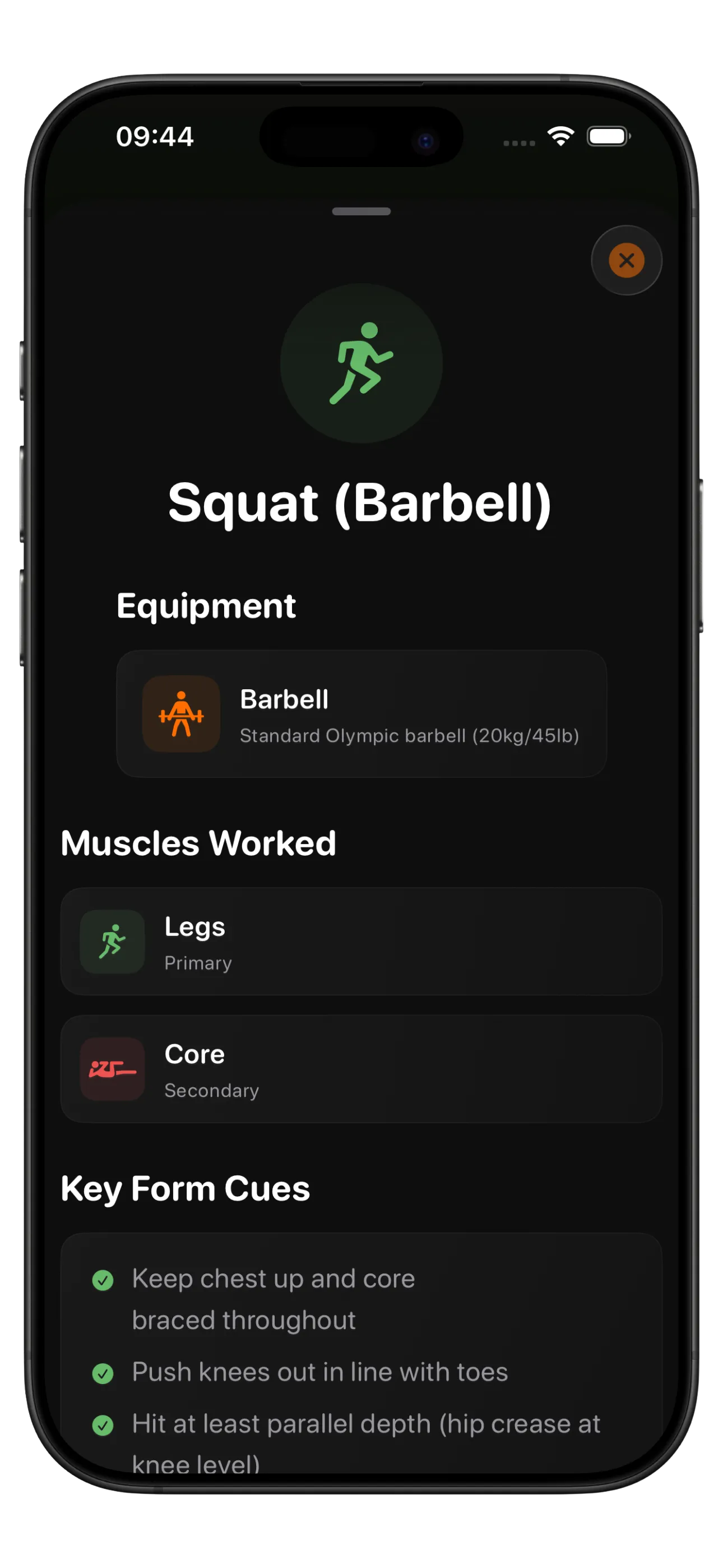
IronStreak includes bench press variations (flat barbell, flat dumbbell, incline barbell, incline dumbbell, decline barbell, close-grip barbell) in the free chest exercise library. Each exercise has a built-in form info sheet with the cues and common mistakes from this article — one tap during your workout, no leaving the app.
Every set is logged with weight and reps. Your estimated 1RM appears as a chart in the Progress tab, so you can see your bench press going up over weeks and months. The app pre-fills your last session's numbers with "beat last session" indicators — small arrows showing whether today's set is more reps or more weight than last time. That's progressive overload, automated.
PRs trigger a trophy celebration and add to your all-time bench press record on the PR Board. Over months, that record becomes a visual story of progress you can scroll back through — which tends to keep you benching.
FAQ
What is proper bench press form?
Feet planted flat, scapulae retracted and depressed, slight natural arch, grip slightly wider than shoulder-width, elbows tucked to 45–75°, bar lowered to mid-chest under control, diagonal press path up and slightly back toward the face, full lockout without losing scapular position.
How wide should my grip be on bench press?
Wide enough that your forearms are vertical at the bottom of the rep — typically index fingers on or near the knurling rings, about 1.5 to 2 times shoulder-width.
Should I arch my back when benching?
A slight natural arch is correct and safe. Extreme powerlifting arches are competition-specific and unnecessary for general strength or hypertrophy. Keep your glutes on the bench.
What's the most common bench press mistake?
Flaring the elbows to 90° from the torso. This is the leading cause of bench-related shoulder pain. Tuck to 45–75°.
Should the bar touch my chest when I bench press?
Yes. Full range of motion on every rep. Lower to mid-chest or just below the nipples under control. Don't bounce.
How often should I bench press per week?
Twice per week is optimal for most lifters. Once is fine for maintenance; three times is only worth it for advanced lifters with strong recovery.
Key Takeaways
- Setup is half the lift. Feet planted, scapulae retracted, small natural arch, tight grip — every rep.
- Elbows at 45–75° from the torso. Not 90°. This one cue prevents most shoulder injuries.
- Touch the chest every rep. No bounce. Full range of motion beats partial reps for long-term gains.
- Bar path is diagonal, not vertical — up and slightly back toward your face.
- Bench twice per week. Track every set. Aim for +1 rep or +2.5 kg each session.