The Push Pull Legs split is the most popular workout structure in strength training for a reason. It organizes your training by movement pattern rather than individual muscle groups, which means every session is balanced, recovery is built in, and it scales from 3 days per week to 6 without needing a completely different program.
Whether you're a beginner looking for your first structured routine or an intermediate lifter considering a switch from a bro split, this guide covers everything you need to know about PPL: how it works, how to program it, which exercises to include, how to progress, and the most common mistakes to avoid.
In This Guide
- What Is Push Pull Legs?
- PPL for 3 Days vs 6 Days
- The Complete PPL Exercise List
- How to Progress on PPL
- PPL vs Upper Lower vs Bro Split
- Common PPL Mistakes
- Get Your PPL Routine in IronStreak
What Is Push Pull Legs?
Push Pull Legs (PPL) divides your training into three workout types based on the primary movement pattern:
Push Day trains all the muscles involved in pushing movements: chest, shoulders, and triceps. Think bench press, overhead press, lateral raises, and tricep extensions. Every exercise on push day involves extending your arms away from your body.
Pull Day trains the muscles involved in pulling movements: back, biceps, and rear delts. Rows, pull-ups, lat pulldowns, face pulls, and curls. Every exercise involves bringing weight toward your body or pulling your body toward a fixed point.
Leg Day trains your entire lower body: quads, hamstrings, glutes, and calves. Squats, deadlifts, leg presses, lunges, and calf raises. This is the day most people try to skip -- don't.
Why PPL Works
The structure has several built-in advantages:
- Natural recovery. After push day, your chest, shoulders, and triceps rest while you train pull and legs. Each muscle group gets at least 48 hours of recovery before being trained again.
- Compound efficiency. On push day, bench press already works your triceps, so the isolation work at the end is finishing an already-fatigued muscle rather than trying to hit it cold. Same principle on pull day -- rows and pulldowns pre-exhaust your biceps before curls.
- Balanced development. By training push and pull equally, you avoid the common imbalance where lifters overdevelop their chest and front delts while neglecting their back and rear delts.
- Scalable frequency. Run it once through (3 days) or twice through (6 days) depending on your schedule and recovery capacity.
PPL for 3 Days vs 6 Days
The beauty of PPL is that the same framework works at different training frequencies. The programming changes slightly, but the structure stays the same.
3-Day PPL (Beginner-Friendly)
Schedule: Monday (Push), Wednesday (Pull), Friday (Legs)
Each muscle group gets trained once per week. This is ideal for beginners for several reasons: you have full recovery between sessions, the weekly time commitment is manageable (3 hours total), and you can focus on learning movement patterns without accumulated fatigue.
The tradeoff is that once-per-week frequency is suboptimal for muscle growth. Research suggests training each muscle group twice per week produces better hypertrophy results. But for beginners in their first 3-6 months, once per week is sufficient to make significant progress -- and consistency matters more than optimal frequency at this stage.
6-Day PPL x2 (Intermediate+)
Schedule: Mon (Push), Tue (Pull), Wed (Legs), Thu (Push), Fri (Pull), Sat (Legs), Sun (Rest)
Each muscle group gets trained twice per week, which aligns with the research on optimal training frequency for hypertrophy. The increased volume drives faster progress, but it also demands more recovery capacity. You need adequate sleep, nutrition, and the ability to manage fatigue across six training days.
This is not for beginners. If you're in your first 6-12 months of lifting, the 3-day version will produce better results because you'll actually recover between sessions. Jumping to 6 days before you're ready leads to overreaching, nagging joint pain, and eventually burnout.
IronStreak auto-generates both versions based on your weekly training target during onboarding. If you select 3 days, you get a single PPL rotation. If you select 5-6 days, you get PPL x2 with appropriate volume adjustments. Explore how this works at IronStreak Features.
The Complete PPL Exercise List
Below are recommended exercises for each day. Beginners should start with 3 sets per exercise; intermediate lifters can work up to 4-5 sets. Rep ranges depend on your goal: 5 reps for strength, 8-12 for hypertrophy, 12-15 for muscular endurance.
Push Day
| Exercise | Sets x Reps | Target Muscles |
|---|---|---|
| Flat Bench Press | 3-4 x 6-8 | Chest, triceps, front delts |
| Overhead Press | 3-4 x 6-8 | Shoulders, triceps |
| Incline Dumbbell Press | 3 x 8-12 | Upper chest, front delts |
| Lateral Raises | 3 x 12-15 | Side delts |
| Tricep Pushdowns | 3 x 10-12 | Triceps |
| Overhead Tricep Extension | 3 x 10-12 | Triceps (long head) |
Notes: Start with the heavy compound movements (bench and overhead press) while you're fresh, then move to isolation work. Bench press and overhead press are the core of push day -- everything else is supplementary.
Pull Day
| Exercise | Sets x Reps | Target Muscles |
|---|---|---|
| Barbell Row / Deadlift | 3-4 x 5-8 | Back, biceps, rear delts |
| Pull-Ups or Lat Pulldown | 3-4 x 6-10 | Lats, biceps |
| Seated Cable Row | 3 x 8-12 | Mid-back, rear delts |
| Face Pulls | 3 x 15-20 | Rear delts, rotator cuff |
| Barbell Curl | 3 x 8-12 | Biceps |
| Hammer Curl | 3 x 10-12 | Biceps, brachialis |
Notes: Face pulls are non-negotiable. They balance out all the pressing you do on push day and keep your shoulders healthy. Don't skip them because they don't look impressive. Beginners who can't do pull-ups should use the lat pulldown machine until they build the strength.
Leg Day
| Exercise | Sets x Reps | Target Muscles |
|---|---|---|
| Barbell Squat | 3-4 x 6-8 | Quads, glutes, core |
| Romanian Deadlift | 3-4 x 8-10 | Hamstrings, glutes, lower back |
| Leg Press | 3 x 10-12 | Quads, glutes |
| Walking Lunges | 3 x 10-12 per leg | Quads, glutes, balance |
| Leg Curl | 3 x 10-12 | Hamstrings |
| Calf Raises | 4 x 12-15 | Calves |
Notes: Squats and Romanian deadlifts are the foundation of leg day. If you're a beginner uncomfortable with barbell squats, substitute goblet squats or the leg press as your primary movement until you build confidence. Calves need higher volume because they're used to daily walking -- 4 sets minimum.
All of these exercises are included in IronStreak's exercise library with form cues, common mistakes, and YouTube demonstration links.
How to Progress on PPL
Having the right exercises means nothing if you aren't progressing. The single most important principle in strength training is progressive overload -- systematically increasing the demand on your muscles over time.
Here's the simple progression model that works for PPL:
- Pick a rep range for each exercise (e.g., 8-12 reps for hypertrophy).
- Start at the bottom of the range with a weight you can handle with good form.
- Add reps each session until you hit the top of the range for all sets.
- Add weight and reset to the bottom of the range. For upper body exercises, add 2.5 kg / 5 lbs. For lower body, add 5 kg / 10 lbs.
- Repeat.
For example, if your bench press is at 60 kg for 3 sets of 8, your progression looks like this:
- Week 1: 60 kg x 8, 8, 8
- Week 2: 60 kg x 10, 9, 8
- Week 3: 60 kg x 12, 11, 10
- Week 4: 62.5 kg x 8, 8, 7 (reset with higher weight)
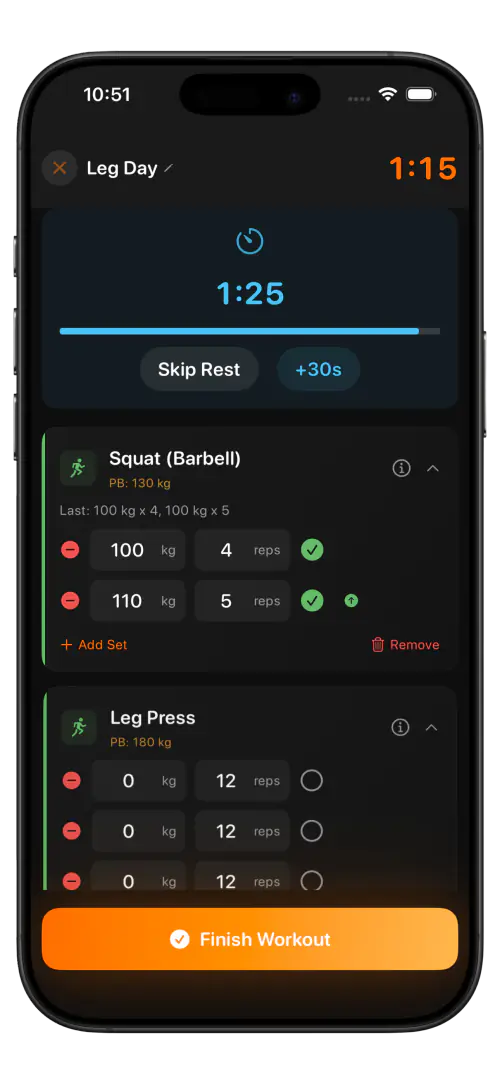
This is where a tracking app becomes essential. You can't progress if you don't know what you did last time. IronStreak pre-fills your last session's data and shows comparison arrows so you can see at a glance whether you're hitting your targets. Your consistency over weeks and months is what drives real results.
PPL vs Upper Lower vs Bro Split
PPL isn't the only way to structure your training. Here's how it compares to the two other popular splits.
PPL vs Upper Lower
Upper Lower splits divide training into upper body and lower body days, typically run 4 days per week (Upper, Lower, Rest, Upper, Lower, Rest, Rest). Each muscle group gets hit twice per week with fewer exercises per session.
Choose Upper Lower if: You can train 4 days per week and want shorter sessions. Upper Lower sessions typically run 45-50 minutes versus 60-75 minutes for PPL.
Choose PPL if: You can train 3 or 6 days and want more exercise variety per muscle group. PPL gives you room for more isolation work.
PPL vs Bro Split
A bro split dedicates one day to each muscle group: Chest Monday, Back Tuesday, Shoulders Wednesday, Legs Thursday, Arms Friday. Each muscle gets hit once per week with high volume in a single session.
Choose a bro split if: Honestly, there's limited reason to. Research consistently shows that training each muscle twice per week (which PPL x2 achieves) produces better results than once per week (which bro splits do). The only real advantage is that each session is focused on fewer muscles, which some lifters enjoy.
Choose PPL if: You want better results with equal or less time commitment. PPL is the bro split's successor for good reason.
Quick Comparison
| Split | Days/Week | Frequency/Muscle | Session Length | Best For |
|---|---|---|---|---|
| PPL (3-day) | 3 | 1x/week | 60-75 min | Beginners |
| PPL (6-day) | 6 | 2x/week | 60-75 min | Intermediate+ |
| Upper Lower | 4 | 2x/week | 45-50 min | Time-limited |
| Bro Split | 5 | 1x/week | 45-60 min | Preference only |
Common PPL Mistakes
1. Skipping Leg Day
The oldest joke in fitness exists because it's true. Legs are the largest muscle group in your body, and training them has systemic benefits: higher testosterone response, more calories burned, better athletic performance, and a physique that doesn't look like an inverted triangle. Do your leg days.
2. Too Much Push, Not Enough Pull
Most beginners gravitate toward bench press, shoulder press, and chest flies while neglecting rows, pull-ups, and face pulls. This creates a muscular imbalance where your front delts and chest overpower your rear delts and upper back, leading to rounded shoulders and eventual shoulder pain. As a rule, match your pushing volume with your pulling volume. If you do 4 exercises on push day, do 4 on pull day.
3. Not Tracking Your Workouts
Progressive overload only works if you know what you did last time. Walking into the gym without knowing your numbers from the previous session means you're guessing -- and guessing doesn't produce systematic progress. Use a workout tracker app or at minimum a notebook. If you're new to tracking, read our guide on the best workout apps for beginners.
4. Going 6 Days Before You're Ready
The 6-day PPL looks appealing on paper -- more training means more gains, right? Not if you can't recover. Beginners who jump to 6 days per week typically experience accumulated fatigue by week 3-4, leading to stalled lifts, joint discomfort, and motivation loss. Start with 3 days. After 3-6 months of consistent training, move to 4 days (upper lower) or 6 days (PPL x2) if your recovery supports it.
5. Ignoring Warm-Up Sets
Don't walk up to the bench press and load your working weight for set one. Do 2-3 warm-up sets with progressively heavier weight: an empty bar for 10 reps, 50% of your working weight for 5 reps, 75% for 3 reps, then your working sets. This prepares the joints, activates the muscle, and reduces injury risk significantly.
Get Your PPL Routine in IronStreak
You can program a PPL split manually using the exercise lists above, or you can let IronStreak do it for you.
During onboarding, IronStreak asks your experience level, fitness goal, and weekly training target. Based on your answers, it auto-generates a complete PPL routine with exercises matched to your level:
- Beginners get machine and dumbbell variations: smith machine bench instead of barbell bench, lat pulldown instead of pull-ups, leg press instead of barbell squats. These are safer to learn and don't require a spotter.
- Intermediate lifters get the barbell compounds listed above plus appropriate isolation work.
- Advanced lifters get higher volume with additional accessory exercises and heavier rep ranges.
Sets and reps are scaled by your goal: strength-focused routines use lower reps (5) with more sets, hypertrophy uses moderate reps (8-12), and muscular endurance uses higher reps (12-15).
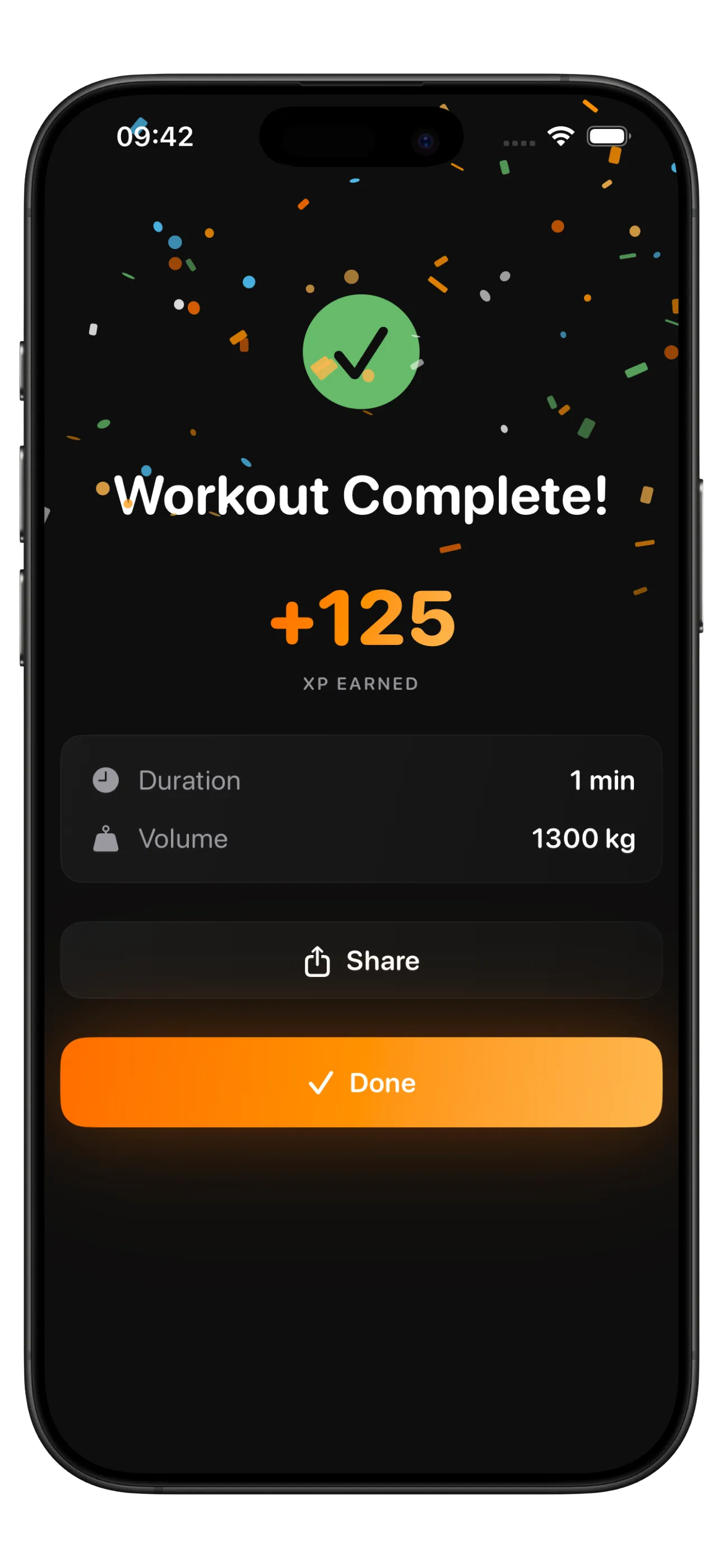
Every exercise includes form cues accessible mid-workout, your previous session's data pre-fills automatically for progressive overload tracking, and the gamification system keeps you consistent through the early weeks when motivation alone isn't enough.
If you train 3 days per week, you get Push / Pull / Legs. If you train 5-6 days, you get PPL x2 with the second rotation adjusted to complement the first. Check out pricing details to see what's included in the free tier.
Final Thoughts
Push Pull Legs is the sweet spot for most lifters. It's simple enough for beginners to follow, flexible enough to scale with your progress, and balanced enough to build a complete physique without overtraining any muscle group.
The key principles are straightforward: train push, pull, and legs on separate days. Start with compounds, finish with isolation. Progress by adding reps, then adding weight. Track everything. Be consistent.
If you want a ready-made PPL routine tailored to your experience level, download IronStreak and let the onboarding build one for you. No programming required -- just show up and train.