Starting at the gym is overwhelming. You walk in, see rows of machines you don't recognize, watch experienced lifters move through their routines with confidence, and realize you have no idea what to do first. The right workout app can remove that friction entirely -- giving you a plan, teaching you proper form, and guiding you through every session until the gym starts to feel like home.
But here's the problem: most workout tracker apps are built for experienced lifters. They assume you already know what exercises to do, how to structure a routine, and what progressive overload means. For a beginner, opening one of these apps can feel just as confusing as standing in front of the cable machine for the first time.
So what do beginners actually need? And which apps deliver it? We tested five of the most popular workout apps in 2026 specifically through the lens of someone who's new to the gym.
In This Guide
- What Beginners Need in a Workout App
- The 5 Best Workout Apps for Beginners (Ranked)
- Beginner Feature Comparison Table
- Why Gamification Matters for Beginners
- How to Get Started
What Beginners Need in a Workout App
Before ranking any apps, let's establish what actually matters for someone who's new to lifting. The requirements are fundamentally different from what an intermediate or advanced lifter needs.
1. Pre-Built Routines (Don't Make Me Program My Own)
The single biggest barrier for beginners is not knowing what to do. An app that drops you into an empty workout screen and expects you to pick exercises is useless for someone who doesn't know the difference between a Romanian deadlift and a conventional deadlift. Beginners need ready-made routines that are structured, balanced, and appropriate for their experience level -- ideally auto-generated based on their goals and available training days.
2. Exercise Form Guidance (I Don't Know What I'm Doing)
Knowing which exercises to do is only half the problem. You also need to know how to do them. Beginners need form cues, common mistakes to avoid, and easy access to demonstrations. This information should be available during the workout -- not buried three screens deep in a separate section of the app.
3. Simple Logging (Not 15 Fields Per Set)
Some apps have logging interfaces designed for powerlifters who want to track RPE, tempo, rest periods, and perceived effort for every set. For a beginner, this is noise. You need weight, reps, and a checkmark. That's it. The simpler the logging, the more likely you are to actually do it.
4. A Motivation System (I'll Quit in 3 Weeks Without It)
Research consistently shows that 73% of gym-goers quit within the first three months. The initial motivation from signing up wears off fast. Beginners need something beyond raw discipline to keep showing up -- whether that's streaks, achievements, progress visualizations, or social accountability. The app needs to make consistency feel rewarding before the physical results become visible.
5. Low or No Cost (I'm Not Sure I'll Stick With This)
Asking someone who isn't sure they'll keep going to the gym to pay $13/month for a workout app is a hard sell. Beginners need a generous free tier or a low-cost entry point. The app should prove its value before asking for money.
The 5 Best Workout Apps for Beginners (Ranked)
1. IronStreak -- Best Overall for Beginners
Platform: iOS | Price: Free / Pro $3.99/mo or $29.99/yr
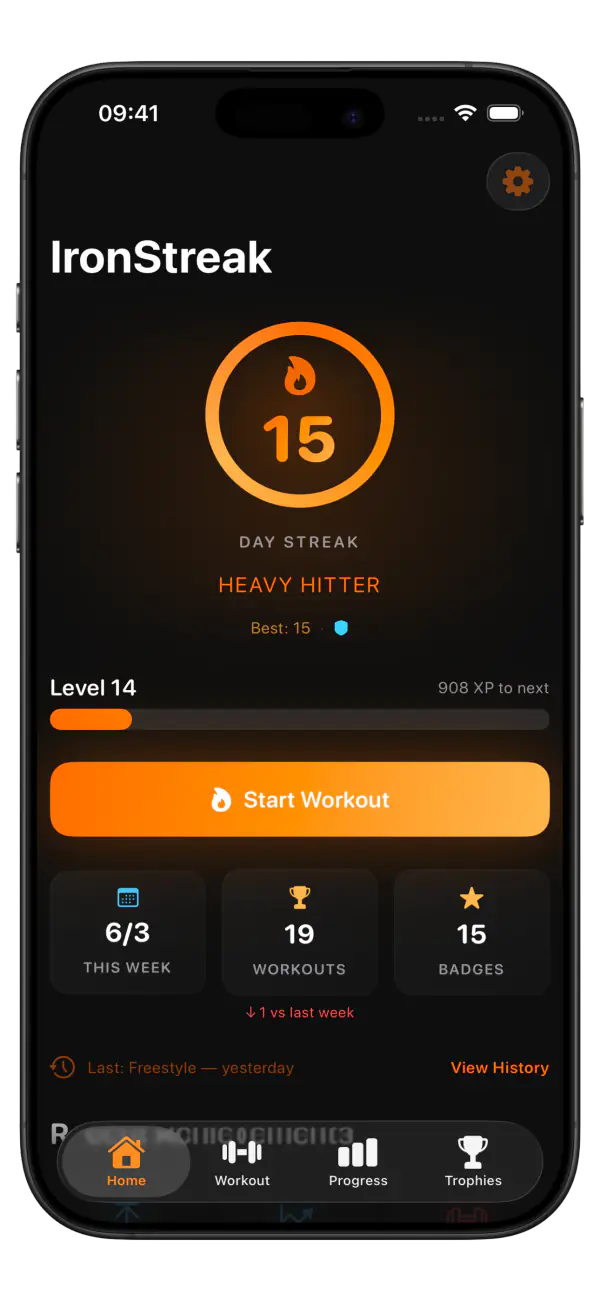
IronStreak was designed with beginners in mind from the start. When you first open the app, a 9-screen onboarding flow asks about your experience level, fitness goals, and how many days per week you can train. Based on your answers, it auto-generates a complete workout routine tailored to your situation.
For beginners, this means routines built around machines and dumbbells rather than barbell compounds. You won't be thrown into barbell squats and deadlifts on day one -- the app starts you with leg presses, smith machine exercises, and dumbbell movements that are safer and easier to learn. As you gain experience, you can swap in more advanced exercises.
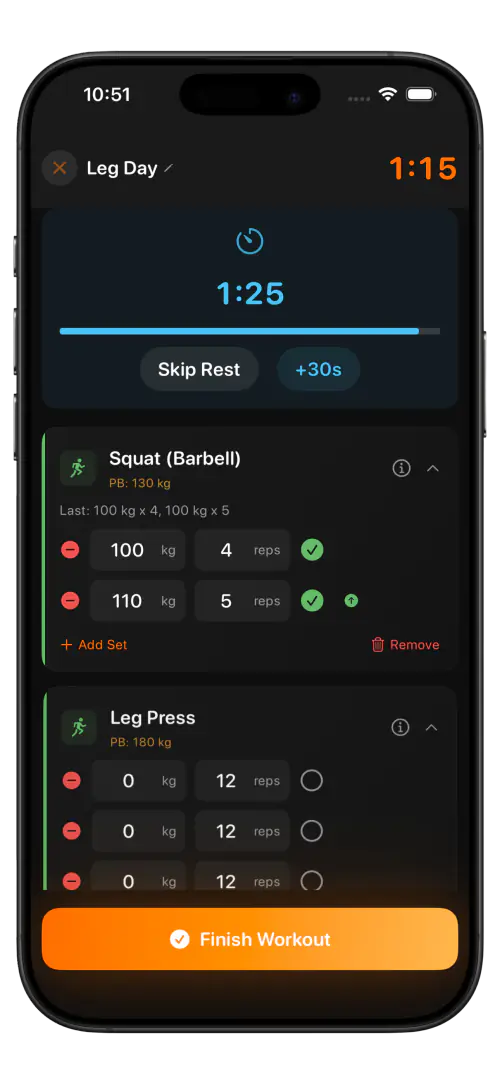
Every exercise in IronStreak includes an info sheet with primary and secondary muscles worked, equipment needed, form cues (specific to each exercise), and common mistakes to avoid. There's also a link to YouTube form guides. Critically, this information is accessible during the active workout with a single tap on the info button -- you don't need to leave your workout to look something up.
The logging interface is simple by design. Each set shows weight and reps (or "BW" for bodyweight exercises, or seconds for time-based exercises like planks). A long-press drag stepper lets you adjust numbers with one hand. Previous session data pre-fills automatically, so after your first workout, you're mostly just confirming or adjusting numbers.
Then there's the gamification. IronStreak includes streaks with a weekly ring, XP earned per workout with multipliers, 20 levels with named titles, and 50 achievements with four trophy tiers each. For beginners, this system is genuinely valuable -- it gives you visible progress and rewards before the physical changes in the mirror become noticeable. When you unlock your first Bronze trophy or level up to "Gym Rat," it feels like you're getting somewhere even in week one.
No account is required. All data stays on your device. The free tier is generous enough to use indefinitely.
Why it's best for beginners: Auto-generated beginner routines, form guidance accessible mid-workout, simple logging, deep gamification for motivation, and a free tier with no account required. It checks every box.
Explore all the features at IronStreak Features, or browse the full exercise library.
2. Fitbod -- Best for "Just Tell Me What to Do"
Platform: iOS, Android | Price: 3 free workouts, then $12.99/mo or $79.99/yr
See our full IronStreak vs Fitbod comparison.
Fitbod uses an AI engine to generate each workout based on your training history, available equipment, and muscle recovery status. You open the app, and it tells you exactly what to do. For beginners who find workout programming overwhelming, this is appealing.
The exercise library includes over 600 movements with video demonstrations, which is excellent for learning form. The AI also accounts for muscle recovery, so it won't program chest again if you trained it yesterday.
The downsides for beginners are significant, though. The free tier gives you only 3 workouts before hitting a hard paywall at $12.99/month -- the most expensive option on this list. That's a steep commitment for someone who isn't sure they'll stick with the gym. The AI also generates different workouts each session, which means you aren't repeating the same routine week to week. For beginners, consistency with a fixed routine is often more effective than variety -- you learn the movements faster when you practice them repeatedly.
Best for: Beginners who have the budget and want zero planning. Not great for beginners who need a consistent routine to build confidence.
3. Hevy -- Best for Social Motivation
Platform: iOS, Android | Price: Free / Pro $8.99/mo or $49.99/yr
Read our IronStreak vs Hevy comparison for details.
Hevy is a solid workout tracker with a social layer. You can follow friends, share completed workouts, and see what others are training. If you're starting at the gym with a friend, the social accountability can keep both of you going.
The logging interface is clean and functional, with workout templates that pre-fill exercises. The exercise library includes animated GIF demonstrations, which are helpful for visual learners.
However, Hevy doesn't generate routines for you. You need to either create your own or find a template online. There's no built-in form guidance beyond the GIF demos -- no form cues, no common mistakes, no contextual help during workouts. For a true beginner, the initial setup requires more knowledge than you might have. It also requires account creation, and the Pro tier at $8.99/month is on the pricier side.
Best for: Beginners who are starting with a gym buddy and want social accountability. Less ideal for solo beginners who need guidance.
4. Strong -- Best for Simple Logging (If You Know What You're Doing)
Platform: iOS, Android, Apple Watch | Price: Free (limited) / Pro $4.99/mo or $29.99/yr
For a detailed breakdown, see IronStreak vs Strong.
Strong is the gold standard for workout logging. The interface is clean, fast, and proven over nearly a decade of development. Millions of lifters use it daily, and for good reason -- it does the core job of logging sets and tracking progress extremely well.
The problem for beginners is that Strong assumes you already know what you're doing. There are no auto-generated routines, no form guidance, no exercise instructions during workouts, and no gamification to keep you motivated. The free tier limits you to 3 saved routines, which means you'll likely hit the paywall quickly.
Strong is the app you graduate to once you know what you're doing. For day one at the gym, it's like being handed a blank spreadsheet.
Best for: Beginners who have a coach or training partner to guide them, and just need a logging tool. Not a standalone solution for true beginners.
5. JEFIT -- Best Exercise Database (But Dated Experience)
Platform: iOS, Android, Web | Price: Free / Pro $6.99/mo or $39.99/yr
JEFIT has the largest exercise database on this list -- thousands of exercises with step-by-step instructions, images, and muscle group maps. The community has also contributed hundreds of workout plans that beginners can browse and follow. The web dashboard is useful for reviewing your progress on a larger screen.
The downside is the user experience. JEFIT has been around since 2010, and the interface shows its age. Logging a set takes more taps and navigation than it should. The free tier is cluttered with ads that make the app feel less polished. For a beginner who's already intimidated by the gym, a clunky app experience adds friction rather than removing it.
Best for: Beginners who want an encyclopedia of exercises and don't mind a dated interface. The community workout plans can be a good starting point if you're willing to dig through them.
Beginner Feature Comparison Table
| Feature | IronStreak | Fitbod | Hevy | Strong | JEFIT |
|---|---|---|---|---|---|
| Beginner Routines | Auto-generated | AI-generated | None (DIY) | None (DIY) | Community plans |
| Form Guidance | Cues + mistakes + YouTube | Video demos | GIF demos only | None | Images + instructions |
| Gamification | Streaks, XP, levels, 50 achievements | None | None | None | Basic |
| Free Tier | Generous | 3 workouts only | Yes (with ads) | 3 routines limit | Yes (ad-heavy) |
| Account Required | No | Yes | Yes | Yes | Yes |
| Monthly Price | Free / $3.99 | $12.99 | Free / $8.99 | Free (limited) / $4.99 | Free / $6.99 |
Why Gamification Matters for Beginners
This deserves its own section because it's the most underrated factor in whether a beginner sticks with the gym.
The physical results of working out -- visible muscle growth, strength gains you can feel in daily life, changes in the mirror -- take weeks or months to become noticeable. For the first 4-6 weeks, you're essentially operating on pure motivation and discipline. That's exactly the window where most people quit.
Research shows 73% of gym-goers quit within three months, and the primary reasons are lack of visible progress and loss of motivation. A gamification system addresses this directly by giving you immediate progress signals: streaks that grow each week, XP that counts up after every workout, levels that unlock, achievements that pop with a celebration animation.
These aren't gimmicks. They're the same psychological principles that make language learning apps like Duolingo effective. Variable rewards, loss aversion (don't break your streak), and visible progress markers create a habit loop that sustains you through the early weeks when discipline alone isn't enough.
IronStreak is the only gym tracker on this list with a full gamification system. If you want to understand the broader landscape, check out our guide to the best gamified workout apps in 2026. And if you want practical tips for building consistency, read how to build a gym streak that actually lasts.
How to Get Started With Your First Workout App
If you're a complete beginner, here's the straightforward path:
- Download IronStreak (free on iOS, no account needed)
- Complete the onboarding -- it takes about 90 seconds. Answer honestly about your experience level and goals. The app uses your answers to generate a personalized routine with exercises appropriate for your level.
- Open your first routine and read through the exercises. Tap the info button on any exercise you don't recognize to see form cues and a YouTube demonstration link.
- Go to the gym and start the workout. The app will guide you through each exercise with pre-set weights, reps, and rest times. Just follow along and log your sets.
- Come back in two days and do it again. The app will pre-fill your last session's data, so you just need to match or beat it. Your streak starts building, XP accumulates, and the first achievements unlock.
That's it. No programming knowledge required. No spreadsheets. No watching 45 minutes of YouTube to figure out a training split. The app handles the complexity so you can focus on showing up and putting in the work.
Explore the full feature set at IronStreak Features, or check out pricing details and our privacy policy.
Final Thoughts
The best workout app for a beginner is one that removes barriers rather than adding them. You need a plan handed to you, guidance on how to do each exercise, a simple way to track what you did, and a reason to come back next time.
Most gym tracker apps are built for people who already have these things figured out. They're great logging tools, but they don't solve the beginner's real problem: not knowing what to do and not having the habit yet.
IronStreak is our top pick because it addresses both problems -- auto-generated routines remove the "what do I do?" question, and gamification addresses the "why should I keep going?" question. It's the only app on this list built specifically for the beginner-to-intermediate journey, and the free tier means there's no financial risk in trying it.
Whatever you choose, start this week. The best app is the one that gets you into the gym consistently. For more on finding the right tracker for your needs, see our comprehensive best workout tracker apps guide.