Here is a number that should bother anyone in the fitness industry: roughly 73% of people who set a gym-related goal give up before the three-month mark. Research from the fitness analytics firm Cardex found that gym attendance drops sharply after the first six weeks, with the steepest cliff between weeks 8 and 12. For New Year's resolutions specifically, studies from the University of Scranton put the failure rate even higher — around 80% by mid-February.
These numbers haven't meaningfully changed in decades, despite an explosion of fitness apps, YouTube tutorials, and Instagram transformation posts. The information is everywhere. The motivation, apparently, is not.
But here is the thing most people get wrong: this isn't a discipline problem. It's a design problem. Gyms are designed for the 20% who are already committed — monthly memberships, open floor plans, minimal guidance. Most fitness apps are designed the same way: here's a log, go track something. The 80% who need help building the habit in the first place are left to figure it out on their own.
Behavioral science has known the fix for years. And one industry — language learning — already proved it works at scale. Let's break down exactly why people quit the gym and what the research says about how to stop.
The 5 Reasons People Quit the Gym
Reason 1: No Visible Progress (The Feedback Gap)
Strength gains are real from the very first week of training, but they're largely invisible. Neural adaptations — your brain learning to recruit more motor units — drive most of the initial progress. You might add 5 lbs to your bench press in week two, but unless you wrote down last week's numbers, you have no idea. The mirror shows nothing. The scale might not move. Your clothes fit the same.
This creates what psychologists call a feedback gap — you're putting in effort but receiving no signal that it's working. Harvard researchers Teresa Amabile and Steven Kramer documented this extensively in their "progress principle" research, published in the Harvard Business Review. Their key finding: of all the things that can boost motivation during a workday, the single most important is making progress in meaningful work. Even small wins matter enormously — but only if you can see them.
The average gym-goer doesn't track workouts in any structured way. They have a vague sense of what they lifted last time. When progress is invisible, motivation evaporates. The fix is straightforward: track every workout. Write down the weights, the reps, the sets. When you can look back and see that your squat went from 135 lbs to 155 lbs in six weeks, the feedback gap closes. The progress becomes visible, and visible progress fuels motivation. For a deeper look at how to structure this tracking, see our guide on progressive overload — the single most important principle in strength training.
Reason 2: No Immediate Reward (The Dopamine Desert)
Your brain runs on dopamine. Not in the pop-science "dopamine hit" sense, but in the deeper neurological sense: dopamine is the molecule of anticipated reward. It's what drives you to pursue things. When you scroll social media, every swipe might reveal something interesting — that unpredictability keeps dopamine flowing. When you play a video game, XP bars fill up, levels unlock, and achievement notifications pop up every few minutes.
Now consider the gym. You walk in. You lift heavy things. You leave sweaty and tired. The reward — a stronger, healthier body — arrives in weeks or months. Your brain, which evolved to prioritize immediate returns, has almost nothing to latch onto in the short term.
B.F. Skinner's research on operant conditioning, conducted over decades at Harvard, showed that variable ratio reinforcement schedules — rewards that come at unpredictable intervals — produce the highest rates of sustained behavior. It's why slot machines are addictive and why Duolingo sends you a congratulatory animation after seemingly random lessons. The behavior gets reinforced at just the right frequency to keep you coming back.
Most gym experiences offer almost none of this. The fix: gamification. XP earned after every workout. Level-ups that arrive just when motivation dips. Achievement unlocks for hitting volume milestones, PR records, or consistency targets. These create the immediate reward loops that the gym experience fundamentally lacks. They don't replace the long-term results — they bridge the gap until those results show up.
Reason 3: No Cost to Quitting (The Streak Effect)
Skipping Monday's workout costs you nothing. There's no penalty, no lost progress indicator, no visible consequence. You just... don't go. And because nothing bad happens, it becomes easier to skip Tuesday. Then Wednesday. Then the week. Then the month.
Daniel Kahneman and Amos Tversky's Prospect Theory, which won Kahneman the Nobel Prize in Economics, demonstrated that humans feel losses approximately twice as strongly as equivalent gains. Losing $100 hurts about twice as much as finding $100 feels good. This asymmetry — called loss aversion — is one of the most replicated findings in behavioral economics.
Streaks exploit this asymmetry brilliantly. When you have a 30-day gym streak going, skipping a workout doesn't just mean missing one session. It means losing 30 days of accumulated effort. The streak creates an artificial — but psychologically very real — cost to quitting. Missing Monday with a streak on the line feels genuinely painful in a way that missing Monday without one simply does not.
This is exactly why the Seinfeld "don't break the chain" method works so well for habit formation. Jerry Seinfeld described marking a red X on a calendar for every day he wrote jokes, then refusing to break the chain of X's. The chain becomes its own motivation. For a deep dive into building gym streaks specifically, see our complete guide: How to Build a Gym Streak That Actually Lasts.
Reason 4: Decision Fatigue (What Do I Do Today?)
You drive to the gym. You walk through the door. And then... what? Which exercises should you do? How many sets? What weight? Should you follow a program? Which program? Push-pull-legs or upper-lower? Is this a chest day or a back day?
This barrage of micro-decisions creates what psychologists call decision fatigue — a well-documented phenomenon where the quality of your decisions deteriorates after making many choices in a row. Research from Columbia University found that people are significantly more likely to choose the "default option" (i.e., doing nothing) when faced with too many choices. In the gym context, the default option is turning around and going home.
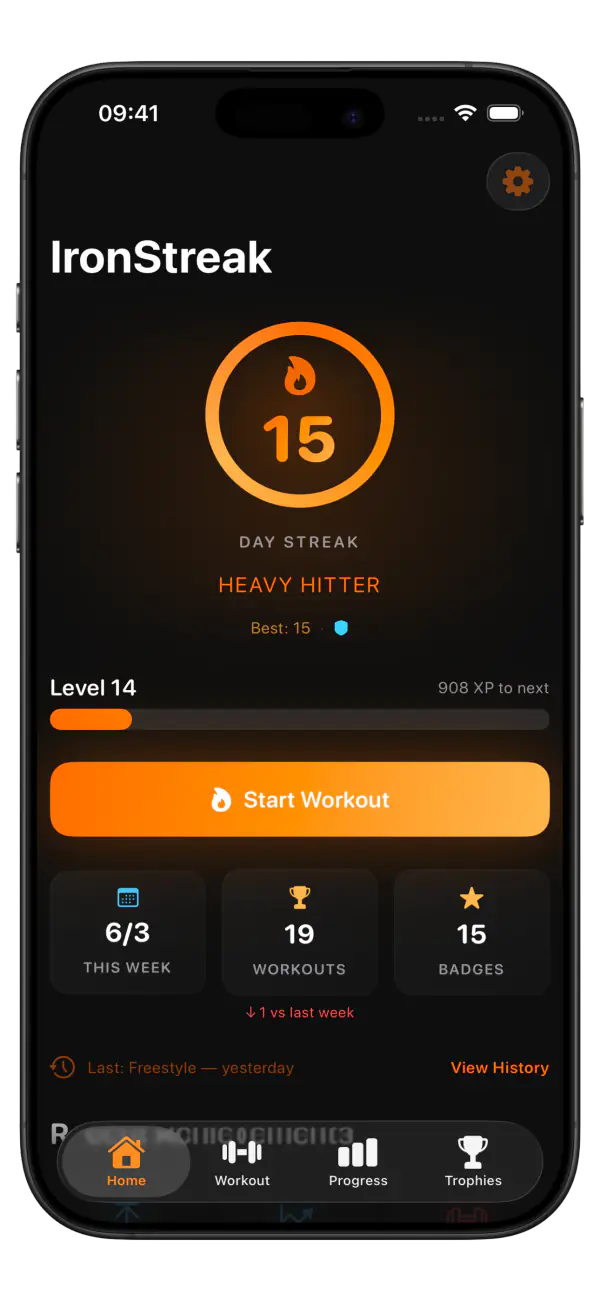
The fix is removing the decisions entirely. Pre-built routines that tell you exactly what to do when you walk in. Open the app, tap "Start Workout," and follow the plan. No thinking required. IronStreak generates personalized routines based on your experience level and weekly schedule — beginners get machine and dumbbell exercises, advanced lifters get barbell compounds and pull-ups, and the sets and reps scale automatically based on your goals. The friction of "what do I do today?" disappears completely.
Reason 5: Social Comparison (Everyone Else Is Stronger)
Social media has created an epidemic of comparison anxiety in fitness. Instagram is full of people deadlifting 500 lbs, running sub-3-hour marathons, and displaying physiques that took a decade (and sometimes pharmaceuticals) to build. Gym social features — leaderboards, shared workouts, community feeds — can make this worse by constantly reminding you where you rank relative to others.
Research published in the Journal of Social and Clinical Psychology found that social comparison on digital platforms is significantly correlated with decreased self-esteem and increased depressive symptoms. For someone who just started going to the gym, seeing other people's numbers can be actively demotivating rather than inspiring.
The fix: private, personal tracking. No leaderboards. No social feed. No way to compare your bench press to a stranger's. Just you versus yesterday. Your only competition is your last workout. This is a deliberate design choice — the comparison that matters is whether you lifted more than last time, not whether you lifted more than someone else. IronStreak is built around this philosophy, and we take your privacy seriously as a result.
The Behavioral Science Fix: How Duolingo Solved This for Language Learning
Language learning has a dropout problem that mirrors the gym almost exactly. Research from the Foreign Service Institute suggests that achieving conversational fluency in a new language takes 600-2,200 hours of study, depending on the language. Most people quit within weeks.
Duolingo cracked this problem so thoroughly that it now has over 37 million daily active users — making it the most popular education app in history. Their solution wasn't better curriculum. It was better behavioral design.
Duolingo's engagement system is built on four pillars, each rooted in behavioral science:
- Streaks (loss aversion): Your daily streak is the first thing you see. Breaking it feels like losing something valuable. Duolingo even sends push notifications — "Your streak is about to end!" — because they know the fear of loss is more motivating than the promise of gain.
- XP (immediate reward): Every completed lesson earns experience points. The XP bar fills up visually. The dopamine loop closes within seconds of finishing a task, not months later.
- Levels (visible progress): You move from Level 1 to Level 2 to Level 3. Even when your Spanish feels exactly the same, the level number goes up. The feedback gap stays closed.
- Achievements (milestone celebration): Badges, trophies, and celebratory animations mark your progress at regular intervals. Each one is a small dopamine reward that reinforces the behavior.
The exact same psychology applies to the gym. The exercises are different. The muscles are different. But the human brain is the same. It still needs visible progress, immediate rewards, fear of loss, and regular celebration to sustain any behavior over time.
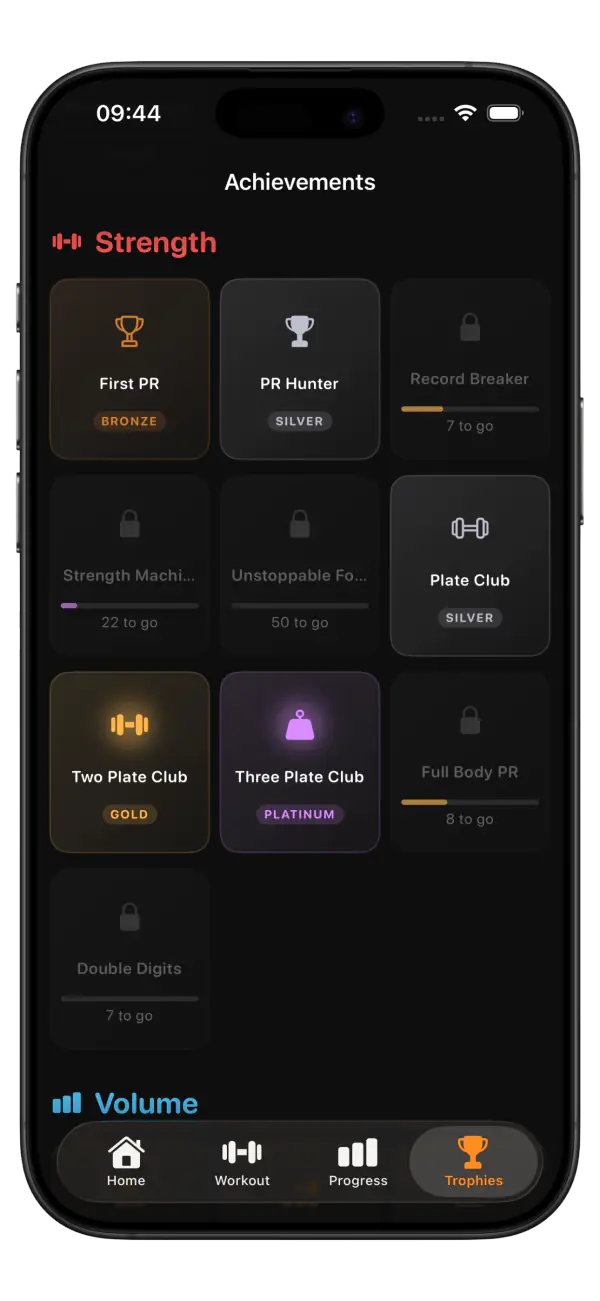
IronStreak applies Duolingo's proven model directly to strength training. Streaks that create real psychological cost to skipping. XP earned after every single workout. 20 levels with titles from "Newbie" to "Olympian." 50 achievements across four trophy tiers — Bronze, Silver, Gold, and Platinum — with unlock celebrations designed to hit at peak motivation moments. It's the behavioral science fix that gyms and most fitness apps have been missing.
What This Looks Like in Practice
Theory is nice. Here's what it actually feels like when these systems are working:
Week 1: You complete your first three workouts using a pre-built routine. Each workout earns XP. By Friday, you've hit Level 2 and unlocked your first Bronze achievement: "First Steps." It's a small thing, but the trophy animation makes you smile. You screenshot it.
Week 4: Your streak hits 20 days. You're now a "Gym Regular" — Level 4. You have 6 achievements. One morning you think about sleeping in instead of training, but then you picture that streak counter resetting to zero. You go to the gym. Loss aversion wins.
Month 3: You've leveled up 6 times. You've earned 10 achievements. Your bench press estimated 1RM is up 15% — you can see the curve climbing on your progress chart. You're not thinking about quitting. You're thinking about hitting Gold tier on your next achievement. You're in the 27% who didn't quit.
The behavioral science didn't change your body composition faster. It didn't make the workouts easier. What it did was bridge the motivation gap between starting and seeing results. By the time the real physical results show up, the habit is already locked in.
5 Practical Tips to Stay in the 27%
Whether you use IronStreak or not, these strategies are backed by the same behavioral science and will help you stay consistent:
Tip 1: Track Every Workout — Even the Bad Ones
A mediocre workout that gets tracked is infinitely more valuable than a great workout that doesn't. Tracking closes the feedback gap. It gives you data. It lets you see, in black and white, that you're getting stronger — even on days when it didn't feel like it. Write down the exercise, the weight, and the reps. Every single time. Our progressive overload guide explains exactly how to use this data to drive continuous improvement.
Tip 2: Start With 2-3 Days Per Week, Not 6
The research is unambiguous: training frequency matters far less than most people think. A 2023 meta-analysis in Sports Medicine found no significant difference in hypertrophy between training a muscle group once versus twice per week, provided total volume was equated. Three well-executed sessions per week will deliver outstanding results for beginners and intermediates alike.
More importantly, setting a target you can actually hit is critical for streak formation. If your target is 6 days and you hit 4, you feel like you failed. If your target is 3 days and you hit 4, you feel like a champion. Same four workouts. Completely different psychological outcome. Lower the bar, then raise it once the habit is locked in.
Tip 3: Use Streaks — The Seinfeld Method
Get a streak counter. Any streak counter. A wall calendar with red X's. A habit-tracking app. A gym-specific streak system. The format matters less than the visibility. You need to see the streak every day so that loss aversion can do its job. Put it where you'll see it first thing in the morning — your home screen, your bathroom mirror, your fridge.
Tip 4: Celebrate Small Wins
Don't wait for a six-pack to celebrate. Celebrate the 7-day streak. Celebrate the first time you add weight to an exercise. Celebrate the 10th workout, the 25th, the 50th. These milestones matter because they provide the immediate reinforcement your brain needs to keep going. Achievement systems — like gamified workout apps offer — automate this celebration, but you can do it manually too. Tell a friend. Post about it. Buy yourself a coffee. Mark the moment.
Tip 5: Remove Friction
Every point of friction between you and your workout is an opportunity to quit. "What exercises should I do?" is friction. "How much did I lift last time?" is friction. "Where do I write this down?" is friction. The best workout apps — compared to traditional trackers like Strong or Hevy — pre-fill your last session automatically so you know exactly what to do and what to beat. Open the app, tap start, and go. Zero decisions required.
The Bottom Line
The gym doesn't need to be a willpower test. The 73% who quit aren't lazy or undisciplined — they're using systems that weren't designed to help them succeed. The behavioral science is clear and has been for decades:
- Visible progress closes the feedback gap (track your workouts).
- Immediate rewards bridge the dopamine desert (XP, levels, achievements).
- Fear of loss makes quitting expensive (streaks).
- Removed friction eliminates decision fatigue (pre-built routines).
- Private tracking eliminates toxic comparison (you vs. yesterday).
This is exactly what gamification provides. It's not about turning the gym into a video game. It's about applying the same psychological principles that keep people learning languages on Duolingo, building code streaks on GitHub, and closing rings on Apple Watch.
If you're tired of starting over every few months, try a different approach. IronStreak was built from the ground up around these behavioral science principles — 91 exercises, progressive overload tracking, PR detection, and the full gamification stack: streaks, XP, 20 levels, 50 achievements, and 4 trophy tiers. It's free to download.
Your next workout doesn't have to be the start of another cycle that ends in three months. It can be the start of a streak that doesn't break.