A safe, strong back squat comes down to seven cues: set the bar at mid-chest height, pick high-bar or low-bar and stay consistent, lock your upper back tight, brace your core after a deep belly breath, descend with hips and knees in sync, hit at least parallel depth, and drive up through mid-foot with chest leading. Miss any of them and you're either capping your squat or grinding your lower back. This guide covers each cue with the anatomy behind it, the most common mistakes, and fixes.
The squat is the most technically demanding compound lift. More than bench or deadlift, squat form separates lifters who make progress for decades from lifters who plateau at 1.5x bodyweight with cranky knees. The cues below are consistent with IPF powerlifting technique, USAW Olympic lifting coaching, and the programming used by Greg Nuckols, Layne Norton, and Jeff Nippard.
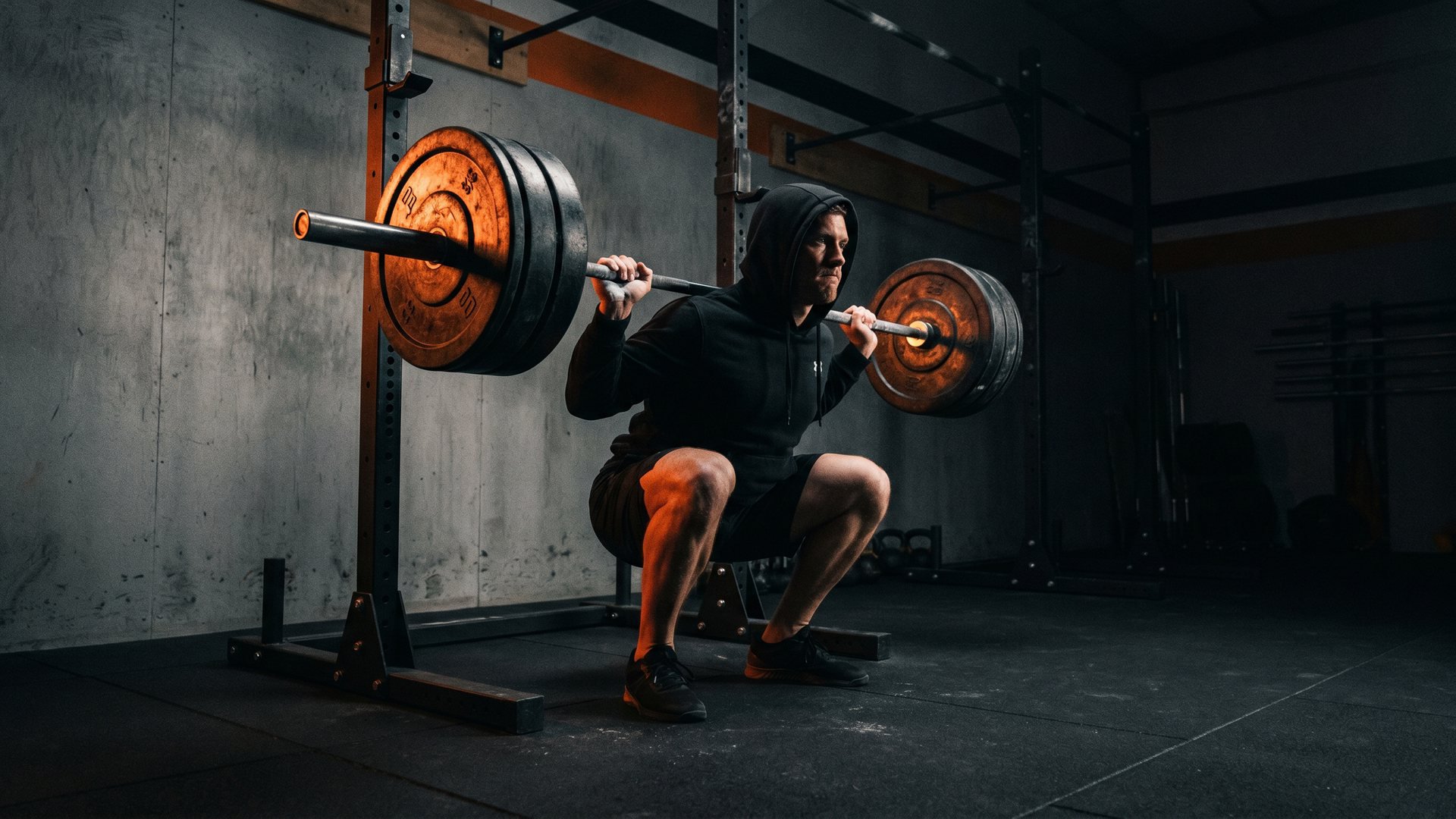
The Setup Is 50% of the Lift
Bad squat reps are almost always failed setups — the descent just exposes them. Take 20 seconds per set to set up correctly. Rushing costs more weight than you'd think.
Cue 1 — Set the Bar at Mid-Chest Height
J-hooks should sit so the bar is just below your shoulder line. When you step under it and stand up, you should rise about two inches to lift the bar off the hooks — not squat it out.
Why it matters: Setting the bar too high means you have to calf-raise to unrack, wasting energy. Setting it too low means you squat the bar to unrack — adding a brutal 80% warmup to every working set.
Common mistake: Bar at eye level. Drop the hooks two settings.
Cue 2 — Choose Bar Placement and Commit
Two valid positions:
- High bar: bar sits on your upper traps, at the base of your neck. Torso stays more vertical. Emphasizes quads. Standard for Olympic lifting and most bodybuilding programs.
- Low bar: bar sits on your rear delts, roughly two inches below high-bar position. Torso leans forward more. Emphasizes glutes and posterior chain. Allows more weight. Standard for powerlifting.
Why it matters: Both positions are proven. Neither is "correct." The mistake is switching between them every month — you never groove either pattern. Pick one, squat it for at least 12 weeks.
Cue 3 — Create Upper-Back Tightness
Once under the bar, pull your elbows down and forward. Squeeze your shoulder blades together hard. The bar should feel locked to your back, not resting on it.
Why it matters: A loose upper back means the bar rolls forward under heavy load, destroying your bar path and dumping you into a forward crash. Tight upper back = stable platform = more weight moved safely. Greg Nuckols calls this "creating a shelf" — build it on every rep.
Common mistake: Elbows flared back like a T-pose. Tuck them down and forward; it engages the lats.
Cue 4 — Stance and Bracing
Feet shoulder-width to slightly wider. Toes angled out 15–30 degrees. Stance width and toe angle are personal — taller lifters and those with longer femurs typically need a wider stance and more toe-out.
Before you descend: take a deep breath into your belly (not your chest). Brace your core as if preparing to be punched in the stomach. Hold that brace for the entire rep, then exhale at the top.
Why it matters: Valsalva bracing increases intra-abdominal pressure, which stabilizes your spine under load. A 2010 study in the Journal of Strength and Conditioning Research found trained lifters' spines produced 40% greater stability under heavy load with Valsalva compared to exhaling during the rep.
The Descent and Ascent
Cue 5 — Break Hips and Knees in Sync
Don't sit back hips-first (that turns the squat into a good-morning). Don't break knees first (that shifts everything to quads and loses posterior chain). Start the descent by unlocking both simultaneously — think of it as "sitting down between your heels."
Knee tracking: Your knees should travel out over your toes, never caving inward. If they cave, think "push knees out" on the way down. This is usually a glute medius weakness — add band walks to accessory work.
Tempo: 2–3 seconds down under control. Bouncing out of the bottom uses tendon elasticity instead of muscle, robs stimulus, and teaches cheats.
Cue 6 — Reach at Least Parallel Depth
The standard: your hip crease passes the top of your knee at the bottom of the rep. Below parallel (ATG — ass-to-grass) is ideal for hypertrophy if your mobility allows and you don't get "butt-wink" (lower-back rounding at the bottom).
Why it matters: A 2019 meta-analysis in Sports Medicine found full squats produced significantly more quad and glute hypertrophy than half squats at matched loads. Half-squatting more weight isn't "bigger muscles" — it's ego.
Common mistake: Stopping 2 inches above parallel. If you can't hit depth with current weight, reduce weight. Building to parallel at 100kg > squatting 150kg to a quarter depth.
Cue 7 — Drive Through Mid-Foot, Chest Leads
Push the floor away through the middle of your feet — not through the heels (which tips you backward) and not through the toes (which tips you forward). Mid-foot keeps the bar over your balance point.
Keep your chest up and eyes forward. If your hips rise before your chest, the squat has turned into a good-morning — stop the set, reduce weight, and focus on "chest up, drive the floor" for every rep.
The 5 Most Common Squat Mistakes
- Hips shooting up first on the ascent. Fix: "chest up, drive through mid-foot."
- Knees caving in. Fix: "push knees out toward pinky toes." Add band walks.
- Heels lifting. Fix: flat shoes or lifting shoes with elevated heel; daily ankle mobility.
- Quarter squatting. Fix: reduce load until you can reach parallel with control.
- Losing upper-back tightness mid-rep. Fix: actively re-brace at the top of each rep before the next descent.
Programming the Squat
- Strength: 3–5 sets of 3–5 reps at 80–90% 1RM, twice per week.
- Hypertrophy: 3–4 sets of 6–10 reps at 65–80% 1RM, twice per week.
- Beginner: 3 sets of 5 reps starting with the empty bar. Add 2.5 kg (5 lb) per session until form breaks, then hold for a week.
Include squat variations — front squat, pause squat, tempo squat — every 6–12 weeks to address weaknesses. The best squat program balances the main lift with posterior chain work (RDLs, good mornings, hip thrusts) and direct quad work (leg press or leg extensions).
How IronStreak Supports Your Squat
IronStreak's legs exercise library includes back squat, front squat, box squat, pause squat, goblet squat, smith machine squat, Bulgarian split squat, and pistol squat. Each comes with the exact form cues from this article built into the app — one tap during your workout, no leaving the session.
Every set is logged with weight and reps, your estimated 1RM charts in the Progress tab, and PRs trigger a trophy celebration. The progressive overload happens automatically — the app shows you last session's best set with "beat last session" indicators.
FAQ
What is proper squat form?
Feet shoulder-width with toes out 15–30°, bar high or low, upper back locked tight, deep belly breath and hard brace, knees tracking over toes, hip crease at or below the knee, mid-foot drive with chest leading.
How deep should I squat?
At minimum, hip crease passes top of knee (parallel). Deeper if mobility allows. Half squats limit hypertrophy.
Should I squat high bar or low bar?
Both work. High bar = more upright, quad-dominant. Low bar = forward lean, glute/posterior chain-dominant, allows more weight.
Why do my knees cave in when I squat?
Usually weak glute medius or cuing error. Fix: "push knees out toward pinky toes" + band-walk accessories.
Should my heels come off the floor?
No. Heels up = limited ankle mobility. Short-term fix: flat/lifting shoes. Long-term: ankle mobility work.
How often should I squat?
Twice per week is optimal for most lifters. Once per week is fine for maintenance.
What's the most common squat mistake?
Hips shooting up before the chest on the ascent. Turns the lift into a good-morning and loads the lower back.
Key Takeaways
- Setup is half the lift. Bar height, placement, upper-back tightness, brace — every rep.
- Hit parallel or deeper. Quarter squats don't build what full squats build.
- Knees track over toes, chest stays up, mid-foot drives the floor.
- Squat twice per week. Track every set. Build for years, not weeks.
- When form breaks, reduce weight. Ego-squatting is the fastest route to a long injury lay-off.